USAID DEC
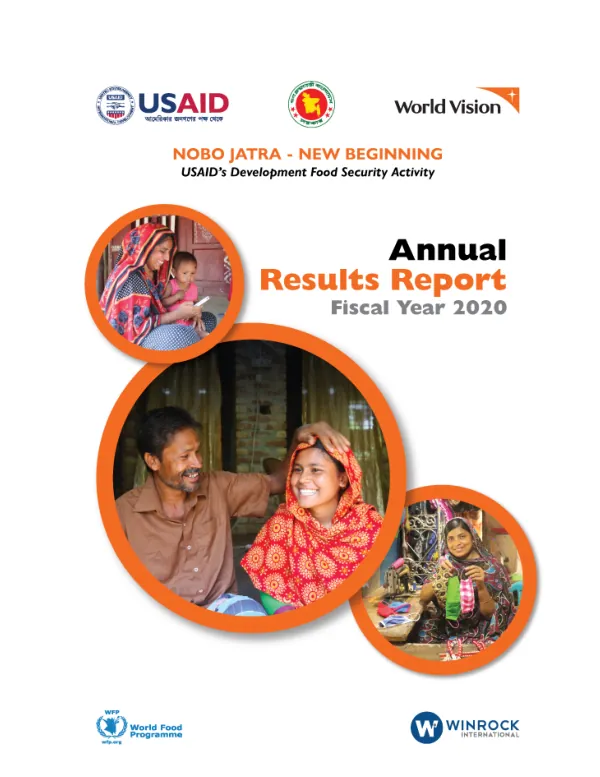
Final Report: Nobo Jatra FY20 ARR, Submission 2 November 2020 revised 3 December 2020
Sign inTHE WORLD FOOD PROGRAMME
Final Report: Nobo Jatra FY20 ARR, Submission 2 November 2020 revised 3 December 2020
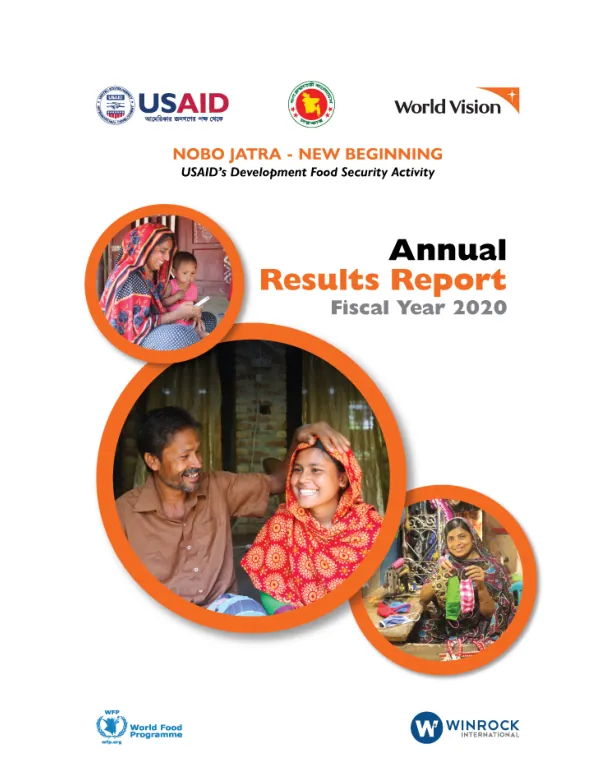
The Nobo Jatra project is a seven-year Development Food Security Activity led by World Vision Bangladesh, in partnership with the World Food Programme and Winrock International.
2020 · 32 pages
Sign in to readA free account is required to download.
Abstract
The project aims to improve gender equitable food security, nutrition, and resilience of vulnerable communities in southwest Bangladesh. The project targets 856,116 direct participants with multi-sectoral interventions in Water Sanitation and Hygiene, Maternal Child Health and Nutrition, gender, agriculture, and alternative livelihoods, disaster risk reduction, and good governance and social accountability. The project is implemented in four Upazilas (sub-districts) in Khulna Division: Dacope and Koyra of Khulna district, and Shyamnagar and Kaliganj of Satkhira district. The goal of the project is to improve the nutritional status of children under five years of age, pregnant and lactating women, and adolescent girls, as well as to increase equitable household income and strengthen the ability of people, households, communities, and systems to mitigate, adapt to, and recover from natural shocks and stresses. The project has four purposes: (1) Improved nutritional status of children under five years of age, pregnant and lactating women, and adolescent girls; (2) Increased equitable household income; (3) Strengthened gender equitable ability of people, households, communities, and systems to mitigate, adapt to, and recover from natural shocks and stresses; and (4) Improved social accountability and national policy engagement of service provision for vulnerable men and women. The project has a consortium partnership with the World Food Programme, which ended on September 30, 2020. However, the World Food Programme will finalize some outstanding activities with their own funds. The project has also had to pivot to implement a COVID-19 response, a cyclone Amphan response, and lay the groundwork for a flood response due to the onset of the COVID-19 crisis and two cyclones in 2019 and 2020. The project has implemented various interventions, including Water Sanitation and Hygiene, Maternal Child Health and Nutrition, gender, agriculture, and alternative livelihoods, disaster risk reduction, and good governance and social accountability. The project has also established partnerships with local Government departments, private sector actors, and communities to strengthen service delivery models. The project has achieved several results, including improved nutritional status of children under five years of age, pregnant and lactating women, and adolescent girls, as well as increased equitable household income. The project has also strengthened the ability of people, households, communities, and systems to mitigate, adapt to, and recover from natural shocks and stresses. The project has also faced several challenges, including the COVID-19 crisis, two cyclones in 2019 and 2020, and continuous flooding in Koyra sub district. The project has had to divert its existing FY20 resources to implement a COVID-19 response, a cyclone Amphan response, and lay the groundwork for a flood response. The project has also had to adjust its budget and timeline due to the COVID-19 crisis and other challenges. The project has a two-year sustainability anchored cost extension scheduled to start in FY21, which will allow for a twelve-month bridge phase Cost Extension (CE). The project has agreed with the USAID Bureau of Humanitarian Assistance (BHA) to implement the bridge phase and CE activities with available CE MTZ funds until BHA confirms FY21 funding.
Related documents