USAID DEC
Empowerment workers cycle to deliver HIV prevention and economic strengthening services to adolescent girls and young women in Tanzania
Sign inFHI 360
Empowerment workers cycle to deliver HIV prevention and economic strengthening services to adolescent girls and young women in Tanzania
The DREAMS program, a USAID- and PEPFAR-supported initiative, aims to empower adolescent girls and young women (AGYW) in Tanzania to avoid HIV infection.
2021 · 6 pages
Sign in to readA free account is required to download.
Abstract
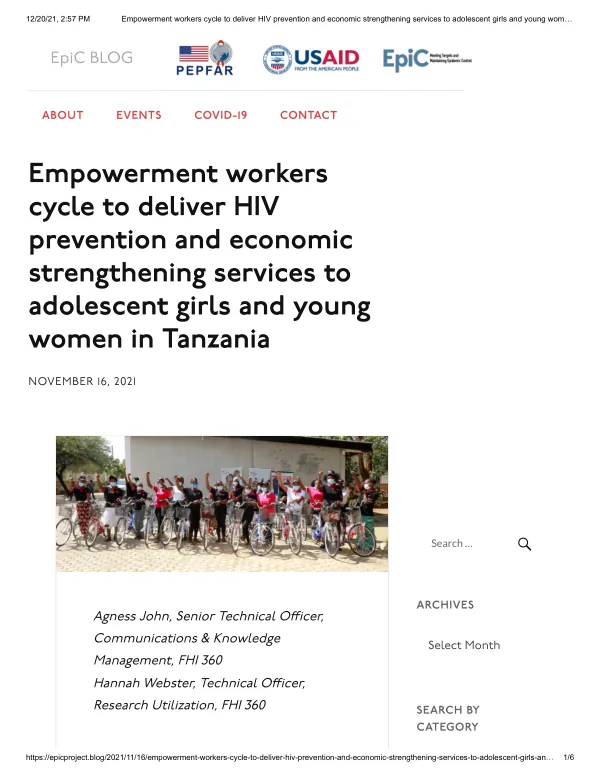
In the Shinyanga region, a rural area with limited transportation infrastructure, empowerment workers face significant challenges in reaching AGYW with essential services. These community members are trained to deliver biomedical, behavior change, and economic strengthening services to AGYW. The distances between households and villages in Shinyanga have hindered the efforts of empowerment workers, who are unable to reach AGYW in remote areas. Winfrida John, an empowerment worker from Majengo Ward in Kahama Town Council, explained that the lack of reliable transportation and sometimes lack of fare has made it difficult to reach the target groups. As a result, AGYW are unable to access economic strengthening opportunities and HIV prevention services, including HIV testing, gender-based violence screening, family planning services, sexually transmitted infection (STI) screening, and pre-exposure prophylaxis (PrEP) services. To address this challenge, the EpiC project distributed 242 bicycles to empowerment workers in the region. The bicycles will help connect the workers to an estimated 48,400 AGYW in Shinyanga. Dr. Philemon Sengati, Shinyanga's regional commissioner, managed the bicycle distribution, along with the EpiC team and local government officials. Dr. Sengati emphasized the importance of interventions for AGYW and called on empowerment workers to reach all targeted AGYW at the ward, village, hamlet, and household levels. The bicycles will enable empowerment workers to link AGYW to opportunities, including mentorship from successful individuals in various fields. Sarah Shija Kitindi, an empowerment worker from Pandagichiza Ward in Shinyanga, noted that the bicycles will minimize associated risks of new HIV infections among AGYW. Dr. Shinje Msuka, the EpiC regional program manager in Shinyanga, observed that improved transportation for empowerment workers leads to improved access to essential services for AGYW. Since its inception, the DREAMS program has reached more than 100,000 AGYW in Shinyanga with behavior change interventions and 20,000 AGYW with biomedical services. The program has also reached 38,000 AGYW through economic strengthening services, which led to 13,200 individuals establishing their own businesses. The distribution of bicycles to empowerment workers is a significant step towards ensuring that AGYW in Shinyanga have access to essential services and opportunities to improve their economic and social well-being.
Related documents