USAID DEC
Monitoring the Integration of Family Planning and HIV Services: Indicators to Measure Progress toward the 90-90-90 Targets and Ensure the Reproductive Rights of All Women
Sign inFHI 360
Monitoring the Integration of Family Planning and HIV Services: Indicators to Measure Progress toward the 90-90-90 Targets and Ensure the Reproductive Rights of All Women
The HIV epidemic disproportionately affects women of reproductive age, especially in sub-Saharan Africa, where nearly 60 percent of people living with HIV are women.
2016 · 8 pages
Sign in to readA free account is required to download.
Abstract
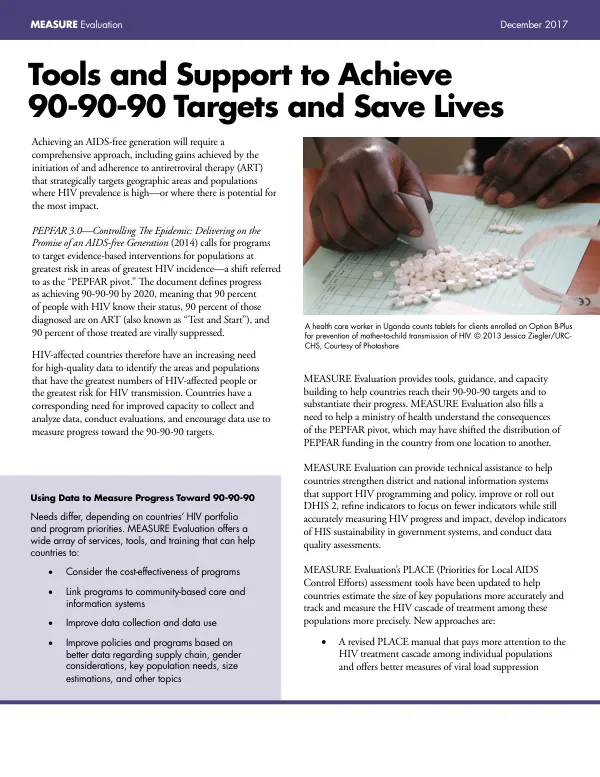
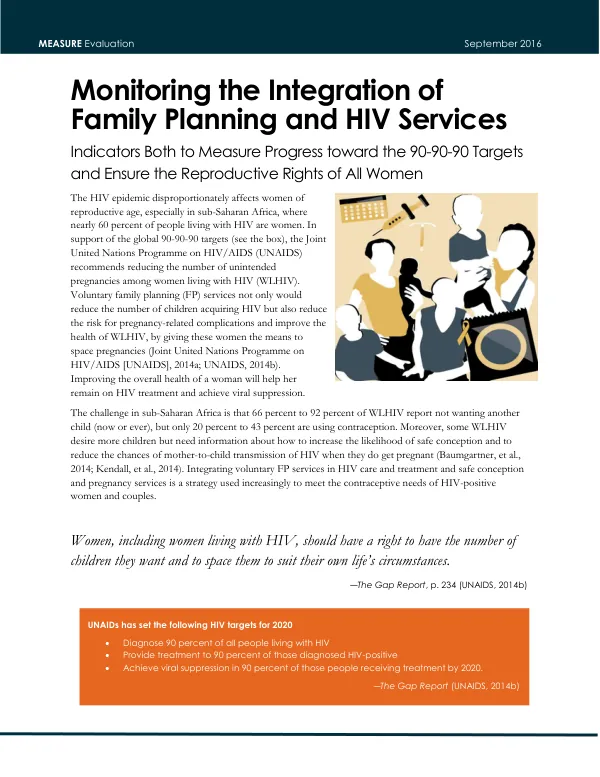
In support of the global 90-90-90 targets, the Joint United Nations Programme on HIV/AIDS (UNAIDS) recommends reducing the number of unintended pregnancies among women living with HIV (WLHIV). Voluntary family planning (FP) services not only reduce the number of children acquiring HIV but also reduce the risk for pregnancy-related complications and improve the health of WLHIV, by giving these women the means to space pregnancies. Improving the overall health of a woman will help her remain on HIV treatment and achieve viral suppression. The challenge in sub-Saharan Africa is that 66 percent to 92 percent of WLHIV report not wanting another child (now or ever), but only 20 percent to 43 percent are using contraception. Moreover, some WLHIV desire more children but need information about how to increase the likelihood of safe conception and to reduce the chances of mother-to-child transmission of HIV when they do get pregnant. Integrating voluntary FP services in HIV care and treatment and safe conception and pregnancy services is a strategy used increasingly to meet the contraceptive needs of HIV-positive women and couples. Women, including women living with HIV, should have a right to have the number of children they want and to space them to suit their own life's circumstances. UNAIDS has set the following HIV targets for 2020: diagnose 90 percent of all people living with HIV, provide treatment to 90 percent of those diagnosed HIV-positive, and achieve viral suppression in 90 percent of those people receiving treatment by 2020. Successful integration of voluntary FP services in an HIV service delivery point (SDP) necessarily involves multiple follow-up and revisit services. This is generally indicated when the SDP can also provide FP screening, counseling for FP needs, and FP methods or referrals so clients can access FP methods not available same day or onsite. However, there is still discussion about how "integrated care" should be defined, and little agreement exists on how it should be measured, especially given the plethora of potentially applicable approaches for organizing integrated FP and HIV service delivery. The appropriateness and feasibility of any particular integration approach are contingent on several factors, including government leadership, available human resources, facility infrastructure, organizational structures, and funding streams. PEPFAR has proposed the following technical platforms as most effective: prevention of mother-to-child transmission of HIV, DREAMS, test and treat, key populations, community-based care and support, and supply chain systems. Measurement of program effectiveness is essential to improve the integration of FP and HIV services, and standard indicators play an important role in assessing program performance.
Related documents