USAID DEC
Technical Intervention Note 2.4: State of the Evidence on Savings Groups and HIV Care
Sign inCARE
Technical Intervention Note 2.4: State of the Evidence on Savings Groups and HIV Care
Savings groups (SGs) have been recognized as a platform for delivering development interventions, particularly in low-cost and sustainable technical assistance.
2015 · 2 pages
Sign in to readA free account is required to download.
Abstract
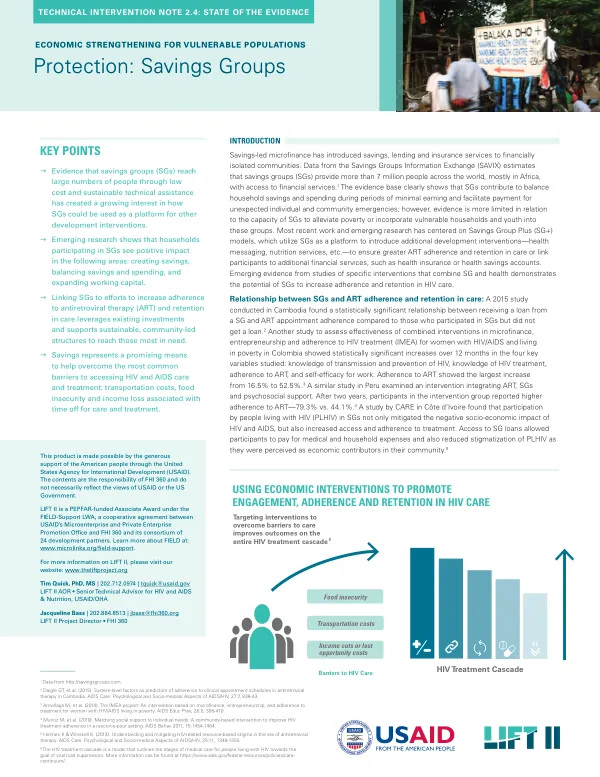
Research has shown that households participating in SGs experience positive impacts in areas such as creating savings, balancing savings and spending, and expanding working capital. Emerging evidence suggests that linking SGs to efforts to increase adherence to antiretroviral therapy (ART) and retention in care can leverage existing investments and support sustainable, community-led structures to reach those most in need. Savings represents a promising means to help overcome common barriers to accessing HIV and AIDS care, including transportation costs, food insecurity, and income loss associated with time off for care and treatment. Studies have demonstrated the potential of SGs to increase adherence and retention in HIV care. A 2015 study conducted in Cambodia found a statistically significant relationship between receiving a loan from an SG and ART appointment adherence compared to those who participated in SGs but did not receive a loan. Another study in Colombia showed statistically significant increases over 12 months in knowledge of transmission and prevention of HIV, knowledge of HIV treatment, adherence to ART, and self-efficacy for work among women with HIV/AIDS and living in poverty. A study in Peru examined an intervention integrating ART, SGs, and psychosocial support. After two years, participants in the intervention group reported higher adherence to ART, with 79.3% adherence compared to 44.1% in the control group. A study by CARE in Côte d'Ivoire found that participation by people living with HIV in SGs not only mitigated the negative socio-economic impact of HIV and AIDS but also increased access and adherence to treatment. The HIV treatment cascade is a model that outlines the stages of medical care for people living with HIV towards the goal of viral load suppression. Research has shown that targeting interventions to overcome barriers to care improves outcomes on the entire HIV treatment cascade. Economic interventions, such as SGs, can promote engagement, adherence, and retention in HIV care by addressing common barriers to accessing care. Studies have also demonstrated the effects of SGs on HIV prevention, including increased use of contraception and increased empowerment of women. A study in South Africa found a 55% reduction in self-reported physical or sexual intimate partner violence in women who received a combined microfinance and life skills training intervention. SGs have also been used to deter sexual transmission, with a study in Mongolia demonstrating a 36% sexual risk reduction in female sex workers over five years through a matched savings program for asset building paired with financial literacy and small business development. The use of social funds to finance health expenditures has also been examined in studies of SG programs in Ghana, Uganda, and Malawi. Results showed that group insurance funds are used on an ongoing basis to finance health emergencies, with a significant proportion of funds spent on healthcare and funerals. These findings highlight the potential of SGs to support economic strengthening and improve health outcomes for vulnerable populations.