USAID
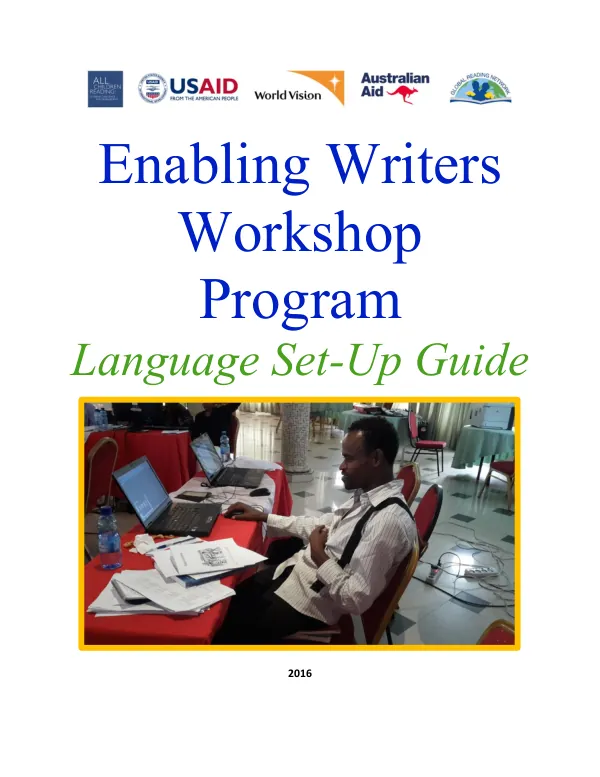
Enabling Writers Workshop Program Language Set-Up Guide
The Enabling Writers Workshop Program is designed to assist teams in setting up language-specific book-writing for decodable and leveled books.
2016 · 8 pages
Sign in to readA free account is required to download.
Abstract
The program's primary goal is to ensure that all books are appropriately leveled for different reading stages of Grades 1 and 2, and targeted toward specific time periods during Grades 1 and 2 reading instruction. To achieve this goal, the program involves several steps, including determining the phonics scope and sequence for grapheme introduction in Grade 1. This scope and sequence is based on the most frequently used letters in the language, which are introduced first to enable children to begin reading simple decodable words. In addition to letter introduction, the program also determines the most frequently used letter combinations, such as th, sh, rt, ng, etc., which are directly taught to children as part of phonics instruction. The program uses a chart to insert the national grapheme scope and sequence or to provide one developed with ministry contacts. The sample chart shows that two letters are introduced each week, with consonants and vowels introduced early on in the process. This approach is common because it enables simple words to be more quickly available for students to read. The next step is to determine decodable stages by clustering sufficient words together to enable simple words to be written in early decodable books. The program uses a chart to identify clusters and determine early sight words, which are those words that can be easily recognized and memorized by children. Early sight words include simple words such as is, are, and, etc., which enable children to begin reading simple sentences. The program also involves leveling set-up, which includes defining the details of levels for book writing. This includes determining the number of levels and cut points, font size and type, pages per book, text density, sentence length and type, words and syllables, content, and illustrations. The program emphasizes the importance of understanding the developmental stages of young learners in Grades 1 and 2 and challenging them at each stage without limiting their access to books. The sample chart provides a detailed example of how to complete the leveling set-up chart, including the number of levels and cut points, font size and type, pages per book, text density, sentence length and type, words and syllables, content, and illustrations. The chart shows how the details of levels are defined to ensure that books are leveled appropriately for different reading stages of Grades 1 and 2. Overall, the Enabling Writers Workshop Program provides a comprehensive framework for setting up language-specific book-writing for decodable and leveled books. The program's emphasis on understanding the developmental stages of young learners and challenging them at each stage ensures that books are leveled appropriately for different reading stages of Grades 1 and 2.