USAID
End of Second and Sixth Grade Evaluation Report 2018
The End of Second and Sixth Grade Evaluation Report 2018 is a study conducted by UNIBE, a USAID-funded initiative, to assess the literacy skills of students in second and sixth grade in the Dominican Republic.
2018 · 85 pages
Sign in to readA free account is required to download.
Abstract
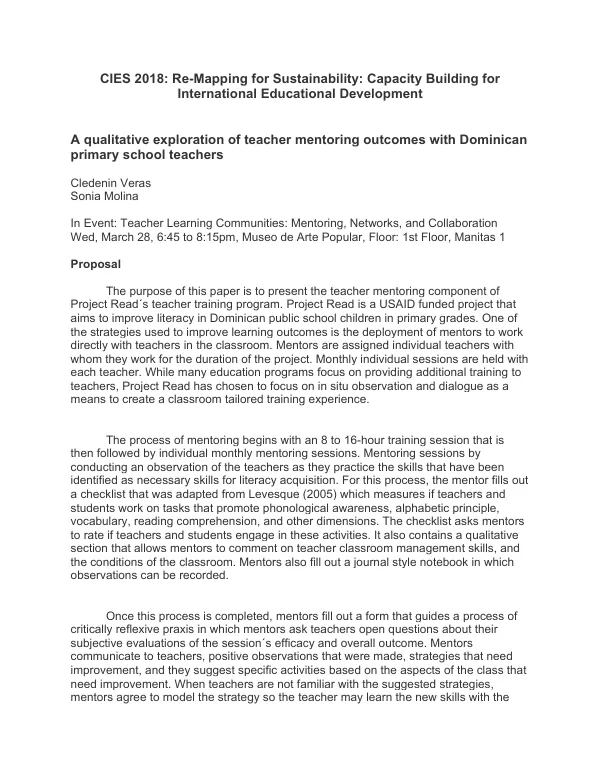
The study aimed to evaluate the effectiveness of Project Read, a program that aims to improve reading outcomes in 200,000 children from 390 Dominican public schools. The evaluation consisted of a short study to test four main literacy sub-skills in second grade (letter knowledge, correct words per minute, fluency, and reading comprehension) and a combination of early and advanced literacy skills in sixth grade (correct words per minute, fluency, literal and inferential reading comprehension, and reading accuracy). The study used a two-stage cluster sampling method, where schools were randomly selected in the first stage and students from second and sixth grade were randomly selected within the chosen schools in the second stage. The study found that 63.7% of learners in second grade demonstrated reading comprehension of grade level text, while 48.1% demonstrated reading fluency on grade level text. In sixth grade, 81.3% of learners demonstrated reading comprehension of grade level text, and 86.7% demonstrated reading fluency on grade level text. The study also found that the percentage of learners who demonstrate reading fluency and comprehension increased at least 10% from the previous 2017 cohort. This represents an increase of 15.3 points in reading comprehension and 10.7 points in reading fluency. Based on the findings, the study recommends continued systematic implementation of identified activities and skills to promote mastery of early literacy skills. It also suggests systematic implementation of decodable texts and leveled readers, as well as promoting supplementary home literacy activities with support from the project's community component. The study's findings and recommendations are significant in understanding the effectiveness of Project Read in improving reading outcomes in the Dominican Republic. The study's results can inform future interventions and policies aimed at improving literacy skills in the country. The evaluation's methodology involved the use of Tangerine, a data collection tool, and the instruments from Project Read's baseline study. The study was conducted in three weeks, and the data was collected from a representative sample of Project Read students. The study's findings have implications for the education sector in the Dominican Republic. The results suggest that Project Read's interventions have been effective in improving reading outcomes, particularly in second grade. The study's recommendations can inform future interventions and policies aimed at improving literacy skills in the country. The study's methodology and findings can also inform future evaluations of literacy programs in the Dominican Republic. The use of a two-stage cluster sampling method and the instruments from Project Read's baseline study can provide a robust and reliable assessment of literacy skills. Overall, the End of Second and Sixth Grade Evaluation Report 2018 provides valuable insights into the effectiveness of Project Read in improving reading outcomes in the Dominican Republic. The study's findings and recommendations can inform future interventions and policies aimed at improving literacy skills in the country.