DEVTECH SYSTEMS, INC.
Lessons from LAC Reads: Espacios para Crecer in Nicaragua
The Espacios para Crecer (EpC) after-school program in Nicaragua's Southern Caribbean Atlantic Autonomous Region (RACCS) aimed to support disadvantaged primary school-age children by providing additional learning time.
2021 · 2 pages
Sign in to readA free account is required to download.
Abstract
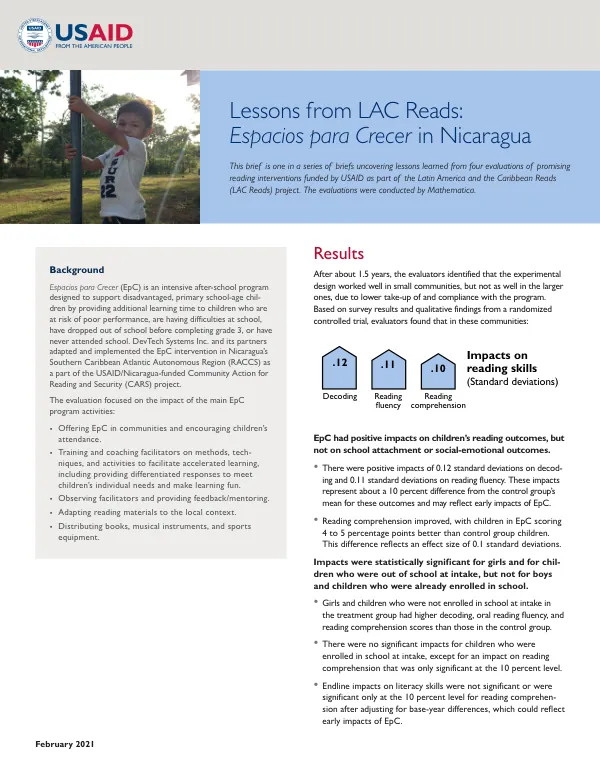
The program was part of the USAID/Nicaragua-funded Community Action for Reading and Security (CARS) project. DevTech Systems Inc. and its partners adapted and implemented the EpC intervention in RACCS. The evaluation focused on the impact of the main EpC program activities, including offering the program in communities, training and coaching facilitators, observing facilitators, adapting reading materials, and distributing books and other materials. The evaluation used a randomized controlled trial design, with two cohorts of students followed for approximately 1.5 years of exposure to the EpC program. The evaluation collected base-year data to measure children's literacy skills and follow-up data for each cohort. The results of the evaluation showed that the EpC program had positive impacts on children's reading outcomes, but not on school attachment or social-emotional outcomes. The program had statistically significant impacts on decoding, oral reading fluency, and reading comprehension, with effect sizes ranging from 0.1 to 0.12 standard deviations. The impacts were greatest for girls and children who were out of school at intake, but not for boys and children who were already enrolled in school. Cost-effectiveness estimates for the EpC intervention ranged from $45 at steady state to $358, including startup costs, per 0.1 standard deviations in literacy score improvement. The cost-effectiveness estimates based on impacts in small communities showed that EpC in RACCS at steady state was in the middle of the range of cost-effectiveness when compared to other education interventions to improve student performance in the Latin America and the Caribbean region. The evaluation highlighted several lessons learned and recommendations for policymakers and implementers. After-school programs that focus on hard-to-reach children can improve early grade reading outcomes, but achieving meaningful impacts may require a heavy investment. Policymakers should consider offering after-school programs to those most likely to benefit in their specific context. The EpC intervention was able to serve a wide range of children successfully, but it faced challenges reaching older children who were not enrolled in school. The evaluation also highlighted the importance of hybrid randomization in implementation conditions that are heterogeneous. Individual randomization can often provide greater statistical power with a smaller sample size than group-level randomization, but if the risks of low take-up and contamination are high, group randomization may be preferable. The experiment in this evaluation was more successful in small communities than in large communities, where take-up and compliance with the research group were low. Evaluators and donors investing in rigorous evaluations should consider hybrid design as a strategy to balance these risks, but close collaboration with implementers and local authorities is needed to understand program implementation and the local context to better interpret evaluation findings.