USAID DEC
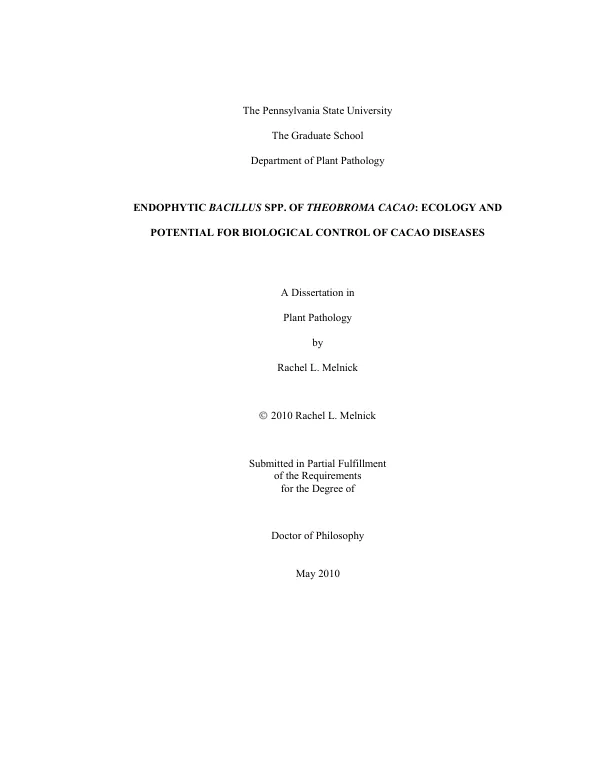
Endophytic Bacillus SPP. of Theobroma Cacao: Ecology and Potential for Biological Control of Cacao Diseases
Sign inPENNSYLVANIA STATE UNIVERSITY
Endophytic Bacillus SPP. of Theobroma Cacao: Ecology and Potential for Biological Control of Cacao Diseases
Theobroma cacao, the chocolate tree, is a major crop in South America, but its yield is drastically limited by disease.
2010 · 175 pages
Sign in to readA free account is required to download.
Abstract
Three key diseases affecting cacao are black pod, caused by Phytophthora spp.; frosty pod, caused by Moniliophthora roreri; and witches' broom, caused by Moniliophthora perniciosa. Chemical control options exist, but farmers typically use cultural disease management such as phytosanitary pruning due to the risks associated with pesticide use in developing countries. There has been increased interest in the use of biological control for managing cacao diseases, particularly with the growing demand for organic chocolate. Research has focused on the potential of endophytic bacteria to manage cacao diseases. Endophytic bacteria are bacteria that live within plant tissues and can provide protection against pathogens. A previous study demonstrated that a Bacillus sp. from tomato was capable of endophytically colonizing cacao foliage and reducing disease severity of Phytophthora capsici in detached leaf assays. This success led to an investigation on endospore-forming bacterial endophytes associated with cacao tissue. Approximately 70 isolates of endospore-forming cacao bacterial endophytes were obtained and screened for characteristics of elite biological control agents, such as chitinase production, ability to colonize clean plants, and disease suppression. Four isolates were tested in a two-year field study on biological control of witches' broom disease at INIAP in Pichilingue, Ecuador. The results showed that application of Bacillus pumilus isolate ET consistently reduced disease severity of witches' broom when applied three times a year and phytosanitary pruning was conducted at the end of each season. The persistence of bacterial endophytes in cacao foliage was also investigated. The results showed that applied bacterial endophytes persisted in cacao foliage throughout the dry season (6-month period) when applied at the season onset. However, bacterial endophytes persisted in the rainy season, but needed to be re-applied midway through the six-month season to maintain adequate population levels. In addition to research on suppression of witches' broom, the four bacterial isolates were tested for their ability to suppress cacao pod disease and cherelle wilt in two cacao genotypes: "Nacional" and "CCN51". Bacillus pumilus ET reduced cherelle wilt in both genotypes, indicating the presence of a biological component associated with what was once thought to be a physiological condition. Further research was conducted to determine the modes of action of the biological control agents. Antibiosis studies indicated that B. pumilus ET was antagonistic to P. capsici and M. roreri, but not M. perniciosa in plate antagonism studies. Research was also conducted using quantitative real-time PCR (Q-PCR) to determine whether colonization of endophytic Bacillus spp. activated the expression of cacao expressed sequence tags (ESTs) related to defense. The results showed that colonization of cacao seedlings with bacterial endophytes activated the expression of cacao ESTs related to plant defense, such as chitinases, pathogenesis-related proteins, and lipoxygenase. The potential of combining endophytic bacteria with endophytic Trichoderma spp. was also investigated. The results showed that bacterial endophytes could successfully exist with Trichoderma spp. when applied either to seeds or foliage. Bacillus spp. persisted in roots, stems, and foliage, while Trichoderma spp. persisted in roots and stems. These species were capable of co-existing in the same niche, therefore could likely be used together in the field. In conclusion, the results reported here indicate that B. pumilus ET would likely make an excellent biological control agent, due to its multiple modes of action and ability to be combined with endophytic Trichoderma spp.
Related documents