PENNSYLVANIA STATE UNIVERSITY
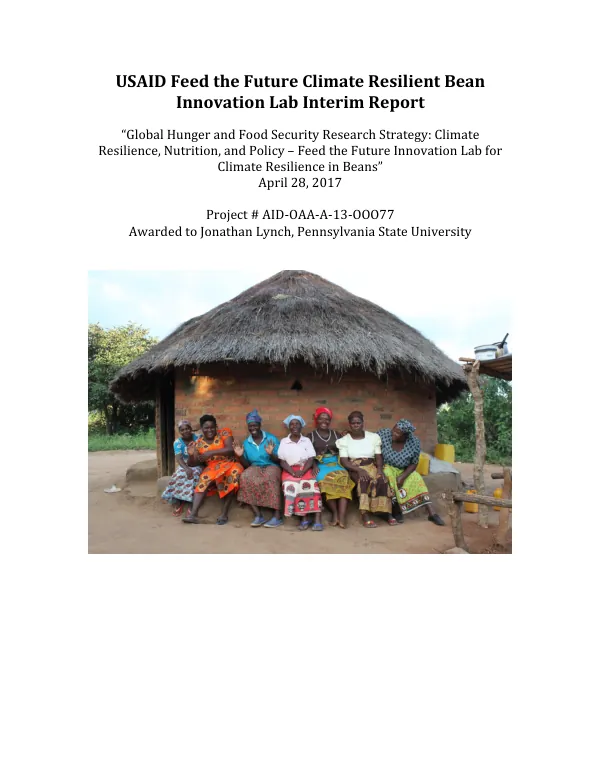
USAID Feed the Future Climate Resilient Bean Innovation Lab Interim Report
The Feed the Future Climate Resilient Bean Innovation Lab for Climate Resilience in Beans is a research project focused on developing climate-resilient bean varieties.
2017 · 30 pages
Sign in to readA free account is required to download.
Abstract
The project began in 2016 and is led by Jonathan Lynch of Pennsylvania State University, with funding from USAID's Food Security Program. The project's main objective is to improve the resilience of bean crops to climate-related stresses such as heat and drought. To achieve this, the project is conducting research on breeding, genomics, and physiology of beans. The breeding program is focused on developing new bean varieties that are tolerant to heat and drought, while the genomics program is aimed at identifying the genetic basis of heat tolerance in beans. The project has made significant progress in breeding for heat tolerance in Andean and climbing beans. A red mottled Andean bush variety, SAB 618, was released in Colombia in 2016, along with two bio-fortified lines, BIO-101 and BIO-107. A black seeded germplasm line and a white seeded cultivar with disease resistance and better performance in low fertility soils are also being developed. The project has also made progress in genomics and breeding for heat tolerance. The heat trial in Alvarado was carried out in the second semester of 2016 to evaluate the pod load of 268 lines of the VEF panel. Significant genetic variability and promising results were observed, with many lines scoring 7-9 with hardly any pods formed at all, but a smaller number of lines looked good and will be targets for future work. The project is also conducting research on a climbing bean population (G2333 x MAC27) under heat stress. Data on pollen viability, pod filling, and yield should help to identify tolerance genotypes and quantitative trait loci (QTL) analysis will help to narrow in on the genetic control for these important components of heat tolerance. The project has also evaluated 157 individual selections of Andean beans in Alvarado, and 8 gametes F3 and 31 gametes F4 were selected under conditions of heat stress. The gametes F3 are of simple crosses, while the gametes F4 are double and triple crosses. Among the crosses in Table 1 (in appendix), SEF 60 is an interspecific source of heat tolerance. The recombinant inbred line (RIL) population IJR x AFR 298 was tested in the same environment in Alvarado for the season between July to November. In this population, 17 traits related to high temperature stress, including pollen viability, were evaluated. Surprisingly, few lines presented truly low pollen viability, suggesting that AFR 298 is not fully sensitive, although heat tolerant parent IJR did present a high value. The project's findings have implications for the breeding community and for programs with limited resources. The results of the project will be used to develop new bean varieties that are tolerant to heat and drought, which will help to improve food security and reduce poverty in developing countries.
Related documents