INSIGHT SYSTEMS CORPORATION
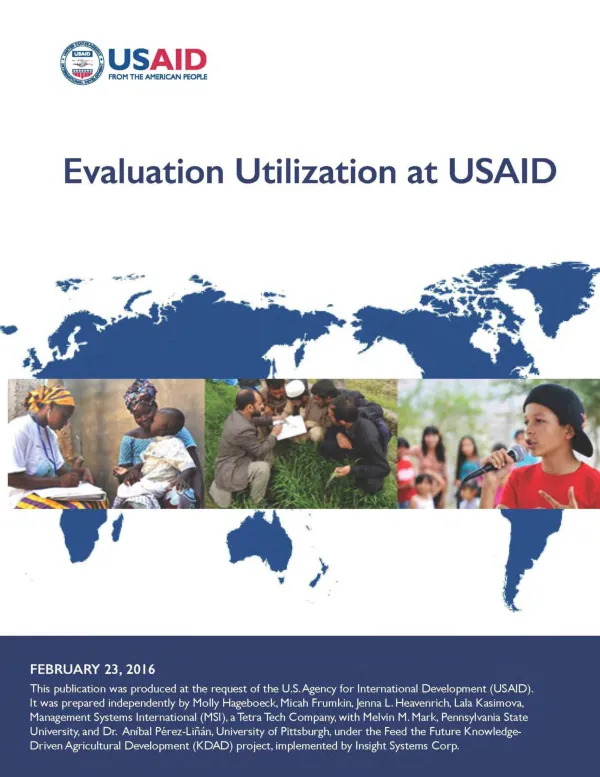
Evaluation Utilization at USAID
The evaluation utilization study at USAID aimed to understand how and when evaluations are used within the organization.
2016 · 227 pages
Sign in to readA free account is required to download.
Abstract
The study was conducted by Management Systems International, a Tetra Tech Company, under the Feed the Future Knowledge-Driven Agricultural Development project. The research team consisted of experts from various fields, including evaluation and meta-analysis, quantitative analysis, and project management. The study focused on four key questions: how and when evaluations are used or not in the program cycle, what changes or decisions are made as a result of evaluations, the degree and conditions under which learning occurs from evaluation findings, and the business processes or enabling conditions that encourage or discourage evaluation utilization. The research team used a mixed-methods approach, combining survey data, interviews, and document reviews to gather information. The study found that evaluations are used throughout the program cycle, with the majority of evaluations being used during the project and activity design and implementation phases. The most common uses of evaluations were to inform project design, monitor progress, and make adjustments to project activities. However, the study also found that evaluations are often not used to their full potential, with many evaluations not being used at all or being used only partially. The study identified several factors that influence evaluation utilization, including the timing of evaluations, the quality of evaluation reports, and the level of engagement from stakeholders. The research team also found that evaluations are more likely to be used when they are conducted in collaboration with implementing partners and when they are used to inform decision-making at the country level. The study's findings have implications for USAID's evaluation policy and practice. The research team recommends that USAID prioritize the use of evaluations to inform decision-making, particularly during the project and activity design and implementation phases. The team also suggests that USAID should provide more support for evaluation capacity building, particularly for implementing partners, and that evaluations should be conducted in a more collaborative and participatory manner. The study's results are based on a survey of completed evaluations, as well as interviews with USAID staff and implementing partners. The survey data showed that the majority of evaluations were conducted in the past five years, with the majority being conducted in the Asia region. The interviews provided more in-depth information on the use and non-use of evaluations, as well as the factors that influence evaluation utilization. The study's methodology included a review of relevant literature, a survey of completed evaluations, and interviews with USAID staff and implementing partners. The research team used a mixed-methods approach to gather information, combining both quantitative and qualitative data. The study's results are presented in a series of tables and figures, which provide a visual representation of the data. The study's conclusions highlight the importance of evaluation utilization in informing decision-making at USAID. The research team emphasizes the need for USAID to prioritize the use of evaluations, particularly during the project and activity design and implementation phases. The team also suggests that USAID should provide more support for evaluation capacity building, particularly for implementing partners, and that evaluations should be conducted in a more collaborative and participatory manner. The study's recommendations are based on the research team's analysis of the data and the literature. The team suggests that USAID should prioritize the use of evaluations to inform decision-making, particularly during the project and activity design and implementation phases. The team also recommends that USAID provide more support for evaluation capacity building, particularly for implementing partners, and that evaluations should be conducted in a more collaborative and participatory manner. The study's results have implications for USAID's evaluation policy and practice. The research team's recommendations are aimed at improving the use and non-use of evaluations, as well as the factors that influence evaluation utilization. The study's findings highlight the importance of evaluation utilization in informing decision-making at USAID, and the need for USAID to prioritize the use of evaluations, particularly during the project and activity design and implementation phases.