USAID DEC
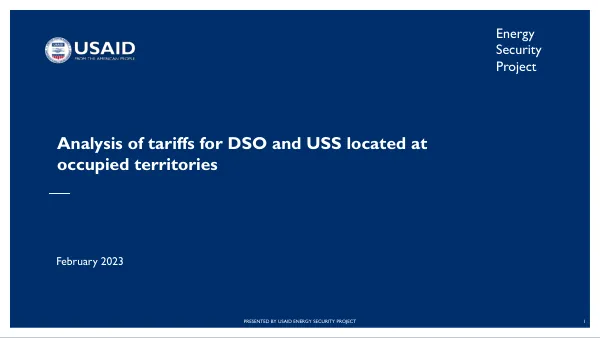
Energy Security Project Analysis of tariffs for DSO and USS located at occupied territories
Sign inTETRA TECH
Energy Security Project Analysis of tariffs for DSO and USS located at occupied territories
The National Energy Regulatory Commission (NEURC) proposed to review tariffs for six Distribution System Operators (DSOs) and four Utility Service Suppliers (USSs) located in occupied territories in Ukraine.
2023 · 8 pages
Sign in to readA free account is required to download.
Abstract
The review aimed to increase tariffs for these entities to align with the approved tariffs for other DSOs and USSs. The proposed tariff increases for the six DSOs are based on the recalculation of the Return on Assets (RR) and the Regulatory Contribution (RC) payments. The RR increase is driven by the increase in payroll expenses, TSO and dispatch tariff costs, and the cost of technological losses. The tariff base for the DSOs remains unchanged, as the consumption on war-affected areas could not be calculated reliably. The proposed tariff increases for the six DSOs are as follows: 43% for the 1st class and 30% for the 2nd class, with a gradual increase in 2Q and 3Q 2023. The average tariffs for the 1st class are proposed to increase from 167.57 UAH/MWh in 2022 to 239.19 UAH/MWh in 2023, while the average tariffs for the 2nd class are proposed to increase from 1,048.23 UAH/MWh in 2022 to 1,357.67 UAH/MWh in 2023. The total RR of all DSOs is proposed to increase by 17% compared to 2022, with an average annual DSO tariff increase of 51% for the 1st class and 37% for the 2nd class. The forecasted volume decrease should be higher considering regular energy outages, and the application of a 20% volume decrease will result in the accumulation of RR deficit. For USSs operated in Kherson, Zaporizhzhia, Donetsk, and Lugansk regions, NEURC proposed to increase tariffs from Q2 2023 by 24% compared to the approved tariffs. The base for all revised USSs tariffs is not changed compared to the 2022 level, which is highly risky and potentially will result in underfinancing of RR. The USAID Energy Security Project (ESP) supports the NEURC's proposal to review the tariffs for 6 DSOs and 4 USSs, as the RR is consistently calculated as other DSOs. However, the tariff base for these entities was not decreased to reflect the war impact, as it has been done with other DSOs' and USSs' tariffs due to unclear information and forecast of consumption. The average tariff increase at occupied territories is comparable to other DSOs and USSs due to its revision on an annual basis with no adjustment on tariff base decrease. NEURC's decisions aimed at smoothing the tariffs' increase result in the accumulation of additional deficit, which should be properly calculated based on regulatory audits and included in further periods based on the mechanism developed by NEURC. Alternatively, this deficit could be partly compensated through State Budget support based on approved legislative acts.