USAID DEC
ENGINE - Ethiopian Health and Nutrition Research Institute (EHNRI) and Tufts University Study on Nutrition Policy Research
Sign inDFID
ENGINE - Ethiopian Health and Nutrition Research Institute (EHNRI) and Tufts University Study on Nutrition Policy Research
The Ethiopian Health and Nutrition Research Institute (EHNRI) and Tufts University Study on Nutrition Policy Research aimed to accelerate the rate of decrease in levels of malnutrition, particularly stunting, in Ethiopia.
2016 · 1 pages
Sign in to readA free account is required to download.
Abstract
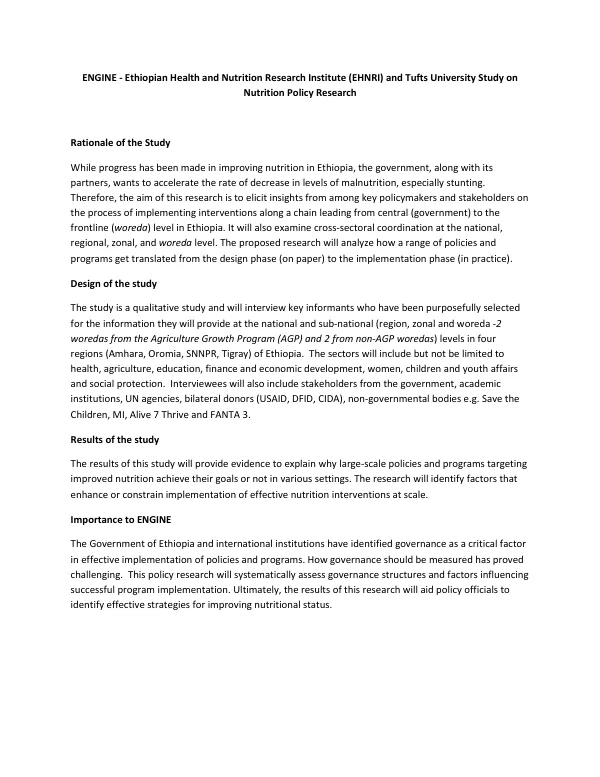
The government, along with its partners, sought to improve nutrition outcomes by examining the process of implementing interventions from the central government to the frontline woreda level. The study also aimed to analyze cross-sectoral coordination at the national, regional, zonal, and woreda levels. The study employed a qualitative approach, involving interviews with key informants at the national and sub-national levels in four regions of Ethiopia: Amhara, Oromia, SNNPR, and Tigray. The sectors included health, agriculture, education, finance and economic development, women, children and youth affairs, and social protection. Stakeholders from the government, academic institutions, UN agencies, bilateral donors, non-governmental bodies, and other organizations were also interviewed. The study's objectives were to provide evidence on why large-scale policies and programs targeting improved nutrition achieve their goals or not in various settings. The research aimed to identify factors that enhance or constrain the implementation of effective nutrition interventions at scale. The study's findings were expected to aid policy officials in identifying effective strategies for improving nutritional status. The Government of Ethiopia and international institutions have identified governance as a critical factor in the effective implementation of policies and programs. The study systematically assessed governance structures and factors influencing successful program implementation. The results of this research will provide insights into how governance should be measured and will inform policy officials on effective strategies for improving nutritional status. The study's focus on cross-sectoral coordination and governance structures is crucial in understanding the complexities of implementing large-scale policies and programs. By examining the process of implementation from the central government to the frontline woreda level, the study aims to provide a comprehensive understanding of the factors that influence the success of nutrition interventions. The findings of this research will contribute to the development of effective strategies for improving nutritional status in Ethiopia.
Related documents