SAVE THE CHILDREN FUND
Feed the Future Ethiopia Growth through Nutrition Activity
Feed the Future Ethiopia Growth through Nutrition Activity is a five-year multi-sectoral nutrition and Water, Sanitation, and Hygiene (WASH) project implemented in four regions of Ethiopia.
2016 · 2 pages
Sign in to readA free account is required to download.
Abstract
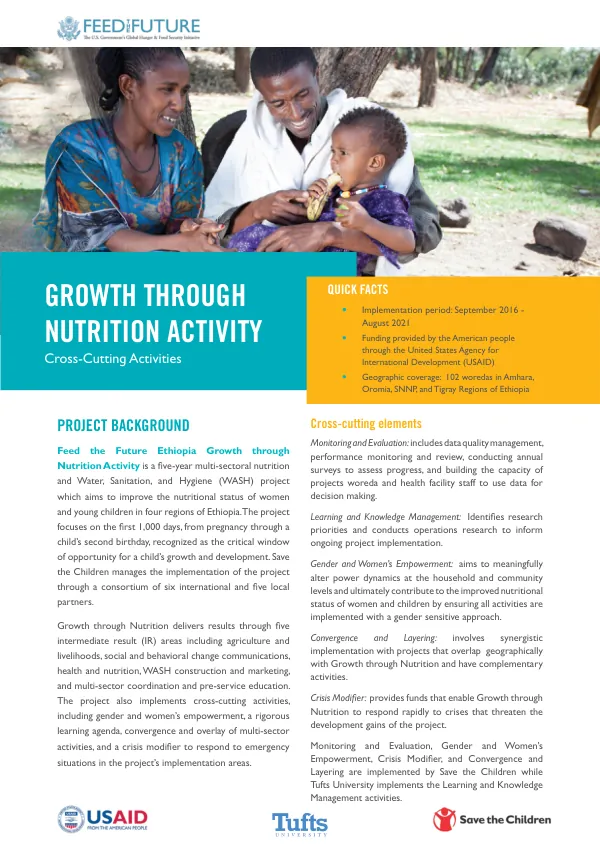
The project aims to improve the nutritional status of women and young children, focusing on the first 1,000 days from pregnancy through a child's second birthday. This critical window of opportunity is recognized as essential for a child's growth and development. The project is managed by Save the Children through a consortium of six international and five local partners. Growth through Nutrition delivers results through five intermediate result areas, including agriculture and livelihoods, social and behavioral change communications, health and nutrition, WASH construction and marketing, and multi-sector coordination and pre-service education. Cross-cutting activities include gender and women's empowerment, a rigorous learning agenda, convergence and overlay of multi-sector activities, and a crisis modifier to respond to emergency situations. The project's monitoring and evaluation system includes data quality management, performance monitoring and review, conducting annual surveys to assess progress, and building the capacity of woreda and health facility staff to use data for decision-making. The learning and knowledge management component identifies research priorities and conducts operations research to inform ongoing project implementation. The project also focuses on gender and women's empowerment, aiming to meaningfully alter power dynamics at the household and community levels and contribute to the improved nutritional status of women and children. Growth through Nutrition has made significant progress on the ground, particularly in the areas of monitoring and evaluation, knowledge management, gender and women's empowerment, convergence and layering, and crisis response. The project has provided data management and use training to over 2,600 health and agriculture extension workers, health workers, development agents, and woreda nutrition and health management information system experts. Operational research has been conducted on the impact of social and behavioral change communication approaches for improving nutritional status, multi-sectoral coordination for nutrition policy effectiveness, and barriers and facilitators of healthy food production, purchase, and consumption. The project has also implemented various activities to support gender and women's empowerment, including training for national and regional project staff and the distribution of multi-purpose stoves to over 600 most vulnerable households. Convergence and layering activities have been implemented with other projects, such as the Development Food Security Activity, Livelihoods for Resilience, and Value Chain Activity, to support complementary activities ranging from support provided to the Federal Ministry of Health to woreda-based activities. The crisis modifier has been utilized to respond to drought and internal displacement with agriculture, livestock, WASH, and nutrition activities.
Related documents