TETRA TECH
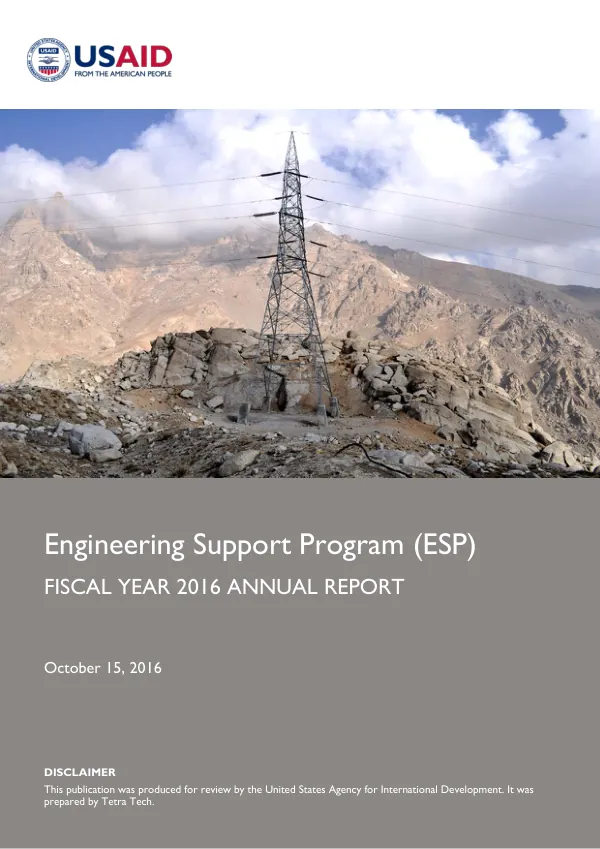
Engineering Support Program (ESP) FISCAL YEAR 2016 ANNUAL REPORT
The Engineering Support Program (ESP) is a technical assistance initiative that provides quick responses to the Office of Infrastructure (OI) in Afghanistan.
2016 · 19 pages
Sign in to readA free account is required to download.
Abstract
The program is staffed by a Kabul-based core of U.S. National (USN) and Cooperating Country National (CCN) architectural and engineering professionals. The team provides planning, design, technical support, and oversight services, as well as contributes to capacity building, mentoring, and collaboration with stakeholders. The ESP contract, No. AID-306-C-16-00010, was signed on July 23, 2016, and has an estimated period of performance of three years with two possible annual extensions. Technical assignments and tasks are categorized as Job Orders (JOs), which are either Time-and-Materials (T&M) or Firm-Fixed Price (FFP) contracts. The ESP team has transitioned eight work orders from the Afghanistan Engineering Support Program (AESP) to Job Orders under ESP. During the reporting period from July 23, 2016, to September 30, 2016, the ESP team focused on project start-up, including security, management, and program support, as well as the transition of work orders. The team also provided technical services, including translation of procurement regulations, and supported the internship program for Afghan women in engineering and architecture. The ESP team has been working on several key projects, including the Arghandi-Ghazni Transmission Line and Substations, the NEPS-SEPS Connector, and the Salang Tunnel Substation. The team has also been providing security services for the Power Transmission Expansion and Connectivity (PTEC) project. Despite some challenges, including outstanding Land Acquisition Resettlement Program (LARP) issues, the ESP team has made significant progress on these projects. The team has worked closely with the contractor and local government to resolve the LARP issues and complete the projects. However, there were 35 security incidents recorded during this reporting period, resulting in damages to the Transmission Towers, ASCR Conductor, and OPGW conductor. The ESP team has also been working on capacity building and mentoring, including the internship program for Afghan women in engineering and architecture. The team has provided technical support and oversight services to the OI mission in Afghanistan, and has contributed to the development of the country's infrastructure. The ESP contract has been categorized into several Job Orders, including Management and Program Support, Security, General Technical Services, and Translation of Procurement Regulation. The team has also been working on several specific projects, including the Arghandi-Ghazni Transmission Line and Substations, the NEPS-SEPS Connector, and the Salang Tunnel Substation. Overall, the ESP team has made significant progress on its projects and has provided valuable technical assistance to the OI mission in Afghanistan. The team continues to work closely with stakeholders to resolve outstanding issues and complete projects.
Related documents
Documents in this collection
 2016
2016USAID DEC
WO-LT-0082 Engineering Support for Vertical Structures Amendment 1 (AMD1) American University of Afghanistan (AUAF) Women’s Dormitory Review of the 100% Partial Site Construction Documents Submittal
Open record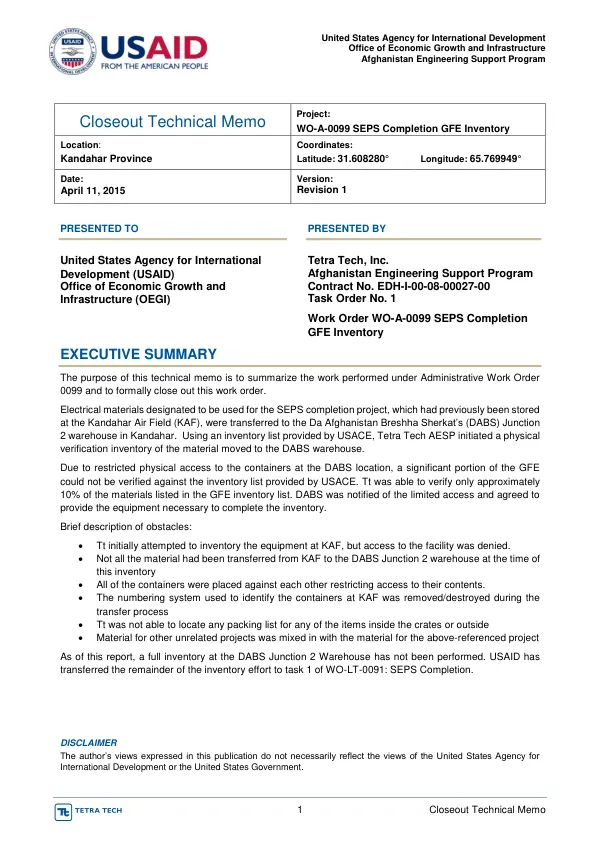 2015
2015USAID DEC
Closeout Technical Memo: SEPS Completion GFE Inventory
Open record