CENTER FOR EDUCATIONAL DEVELOPMENT
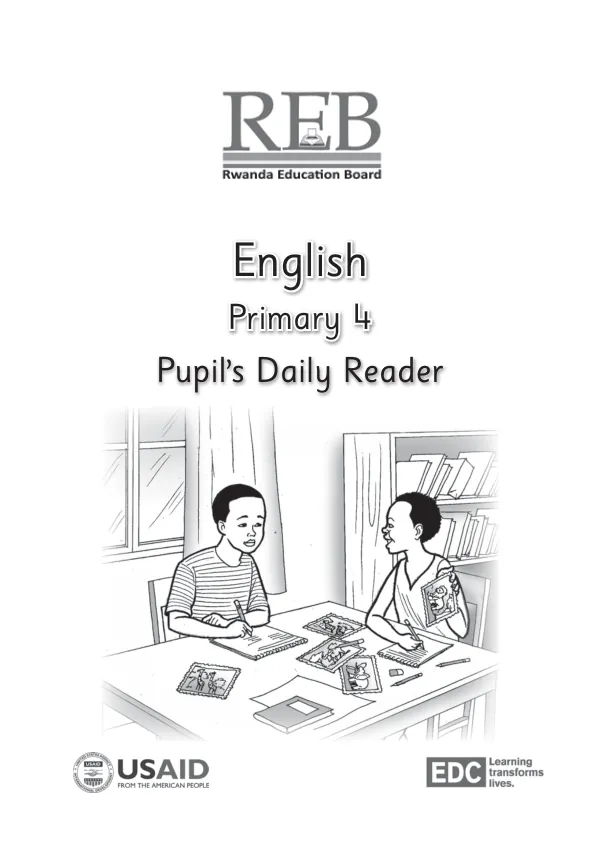
English Primary 4 Pupil’s Daily Reader
The English Primary 4 Pupil's Daily Reader was produced in 2015 by the Rwanda Education Board (REB) with funding from the United States Agency for International Development (USAID) through the Literacy, Language and Learning Initiative.
2015 · 160 pages
Sign in to readA free account is required to download.
Abstract
The book aims to enhance English language culture among Primary 4 pupils during their lower level of primary education. This will allow them to grow up with the language skills that are fundamental for quality education, including reading, writing, listening, and speaking. The book is designed to help learners acquire English language skills progressively through exercises found in each lesson. It follows an approach that progresses from simple to more complex concepts and vocabulary during the learning process. This approach will help the learner in daily learning activities and situations as they develop effective English language skills and knowledge. The book is supplemented with audio lessons that will enhance the learner's ability to listen and speak in English. The book was written based on research carried out in education on effective teaching and learning with learner-centered methodologies that encourage children to actively read, write, listen, and speak. It is hoped that children who will learn using this book and the related audio materials will grow up having basic English language skills and knowledge, which they will be able to apply in their environment and surroundings. The book is divided into ten units, each focusing on a different topic. Unit 1, "Our School," introduces the concept of school and learning. It explains that there are 500 pupils and 20 teachers in the school, and that the pupils study mathematics seven times a week and English every day. The unit also highlights the importance of working together and learning a lot at school. In Unit 1, the pupils are introduced to their teacher, Joy, and their friend John. They learn about the different subjects they study, including mathematics, English, and Kinyarwanda. The unit emphasizes the importance of reading and writing stories, and the pupils are encouraged to take out their books, pens, and pencils every day to learn. The unit concludes by stating that the pupils like to read and write stories, and that they learn a lot at school.
Related documents