DEPARTMENT OF AGRICULTURE
Enhancing Capacity for Low Emission Development Strategies (EC-LEDS)
Low emission development strategies are development plans that promote sustainable social and economic development while reducing greenhouse gas emissions over the medium to long term.
2013 · 2 pages
Sign in to readA free account is required to download.
Abstract
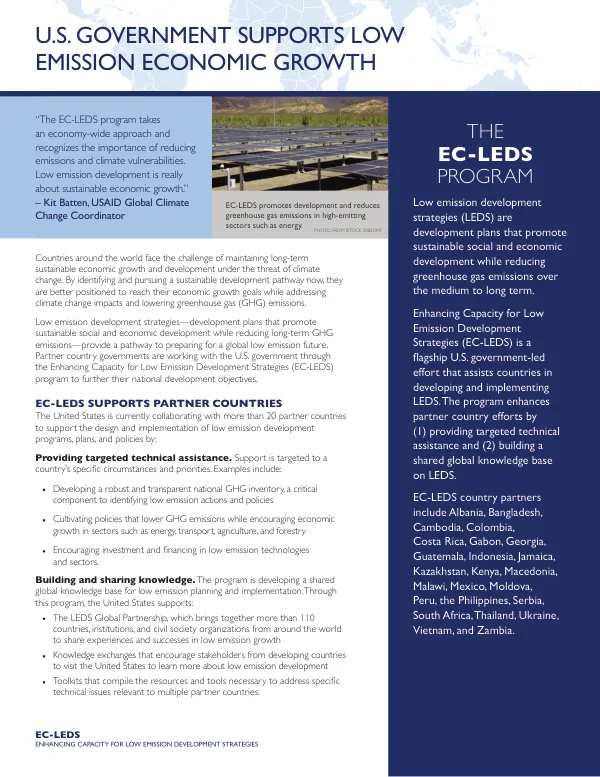
These strategies are critical for countries to maintain long-term sustainable economic growth and development under the threat of climate change. By identifying and pursuing a sustainable development pathway now, countries are better positioned to reach their economic growth goals while addressing climate change impacts and lowering greenhouse gas emissions. The United States is currently collaborating with more than 20 partner countries to support the design and implementation of low emission development programs, plans, and policies. The Enhancing Capacity for Low Emission Development Strategies (EC-LEDS) program provides targeted technical assistance to partner countries, tailored to their specific circumstances and priorities. This assistance includes developing a robust and transparent national greenhouse gas inventory, cultivating policies that lower greenhouse gas emissions while encouraging economic growth, and encouraging investment and financing in low emission technologies and sectors. EC-LEDS also builds and shares knowledge on low emission planning and implementation. The program is developing a shared global knowledge base for low emission planning and implementation, which includes the LEDS Global Partnership, knowledge exchanges, and toolkits that compile the resources and tools necessary to address specific technical issues relevant to multiple partner countries. This shared knowledge base enables countries to learn from each other's experiences and successes in low emission growth. The EC-LEDS program promotes development and reduces greenhouse gas emissions in high-emitting sectors such as energy. The program enhances partner country efforts by providing targeted technical assistance and building a shared global knowledge base on low emission development strategies. EC-LEDS country partners include Albania, Bangladesh, Cambodia, Colombia, Costa Rica, Gabon, Georgia, Guatemala, Indonesia, Jamaica, Kazakhstan, Kenya, Macedonia, Malawi, Mexico, Moldova, Peru, the Philippines, Serbia, South Africa, Thailand, Ukraine, Vietnam, and Zambia. Effective low emission development strategies consider key economic sectors in a country and develop a framework for prioritizing actionable plans to stimulate economic growth with the greatest possible greenhouse gas emissions reductions. A robust LEDS should be country-led and country-owned, inclusive of key economic sectors, forward-looking and long-term, analytically sound, actionable, integrated into national planning processes, and transformative, promoting long-term emissions reductions even as a country experiences economic growth and development. The EC-LEDS program has delivered results in various partner countries, including Bangladesh, Colombia, Mexico, the Philippines, and Gabon. In Bangladesh, EC-LEDS assistance supports the deployment of wind power, a priority for Bangladesh as outlined in its Climate Change Strategy and Action Plan. In Colombia, the program is sponsoring specialists in key economic development ministries to build inter-ministerial support for climate change planning. In Mexico, EC-LEDS assistance has updated Mexico's greenhouse gas emission baseline and is developing a macroeconomic model to better understand the impacts of various low emission development policies. The EC-LEDS program is managed by the U.S. Agency for International Development (USAID) and the U.S. Department of State, with support from the U.S. Department of Energy, the U.S. Environmental Protection Agency, the U.S. Department of Agriculture, and the U.S. Forest Service.
Related documents