USAID DEC
ENI Right-Sizing Process: Report on the Merger of the Europe Bureau and the New Independent States Task Force
Sign inUSAID
ENI Right-Sizing Process: Report on the Merger of the Europe Bureau and the New Independent States Task Force
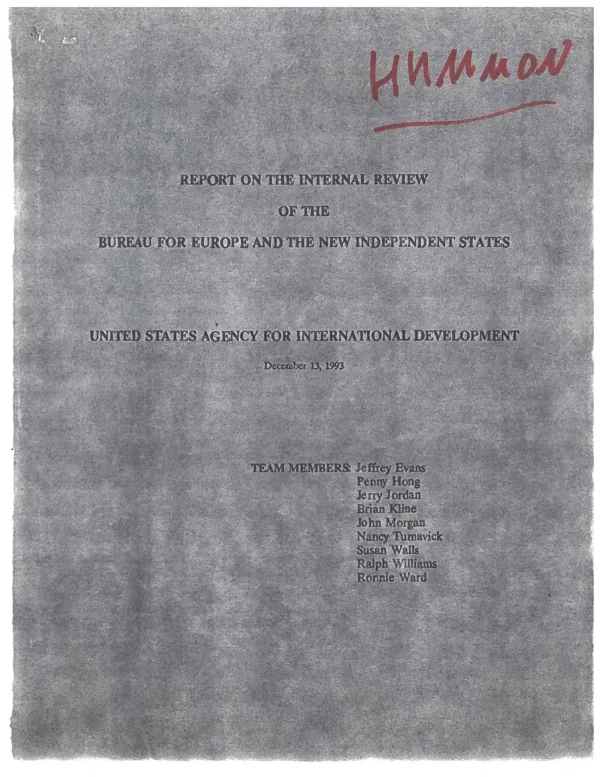
The Europe and New Independent States Bureau (ENI) was established as a result of the merger between the Europe Bureau (EUR) and the New Independent States Task Force (NISTF) in 1993.
2011 · 68 pages
Sign in to readA free account is required to download.
Abstract
The merger aimed to create a more effective structure for delivering assistance to 29 countries, with a program portfolio exceeding $3 billion for FY 1994. The ENI Bureau supports the transition to democracy and market economies in Central and Eastern Europe and the former Soviet Union. The ENI Bureau's programs are structured to respond to the economic and political reforms occurring in the region. These programs involve other Federal agencies, a regional approach to allocating funds, and a demand-driven nature based on the recipient country's capacity to absorb and its preference for U.S. assistance. The programs also have streamlined design and authorization procedures and are managed from Washington. The Europe Bureau's programs focus on four objectives: the transition to full democracy, evolution to market economies, improvement in the quality of life, and U.S. economic assistance to Central and Eastern Europe. The programs are authorized under the Support for Eastern Europe Democracy (SEED) Act, and USAID is responsible for the overall management of the SEED Program. The New Independent States Task Force's programs, on the other hand, focus on four primary objectives: the transition from totalitarianism to democracy, the transition from command economies to market economies, the transition to energy-efficient and environmentally sound growth, and restructuring the state's role in providing financially viable, social service systems while meeting short-term emergency and humanitarian needs. The NIS programs are authorized under the Freedom Support Act of 1992. The Right-Sizing Team applied various management principles in developing the recommendations contained in this report. The proposed structure for the ENI Bureau consists of an Assistant Administrator and two Deputy Assistant Administrators: one for Project Administration and one for Field Support and Bureau Operations. This proposed structure is flattened by combining offices and having no organizational structure below the division level. The Project Administration DAA will have five sector implementation offices reporting: Privatization and Economic Restructuring, Enterprise Development, Human Resources, Energy and Environment, and Democracy and Governance. The Field Support and Bureau Operations DAA will have six offices and staff-level units reporting: European Affairs, NIS Affairs, Program Office, Project Development, Financial Services, and Operational Services. The Team found that the NIS operations are severely understaffed, and although the merger will eliminate some duplication of functions, total staff levels must still increase after the full merger. The use of PSC authorities is expected to continue, with PSCs being replaced by appropriately qualified USDH personnel as they become available from other restructuring within USAID. The Bureau staff repeatedly cited a shortage of adequately trained and motivated support staff as being an impediment to efficiency. Many interviewed cited the procurement process in general and the Office of Procurement (OP) specifically as being major bottlenecks for rapid implementation of projects. Three problems with office space were identified: the lack of adequate space, the non-contiguous character of the space provided, and the lack of quality space. The Regional Mission for Europe (RME) should be abolished, and appropriate delegations of authority should be provided to the DAAs and the Office Directors. An increase in support staff is recommended to help reduce the amount of basic clerical and support functions that project managers currently perform. The unassigned list does not imply that employees are surplus to the needs of the newly established ENI Bureau; they have the skills needed for the Bureau.
Related documents