USAID DEC
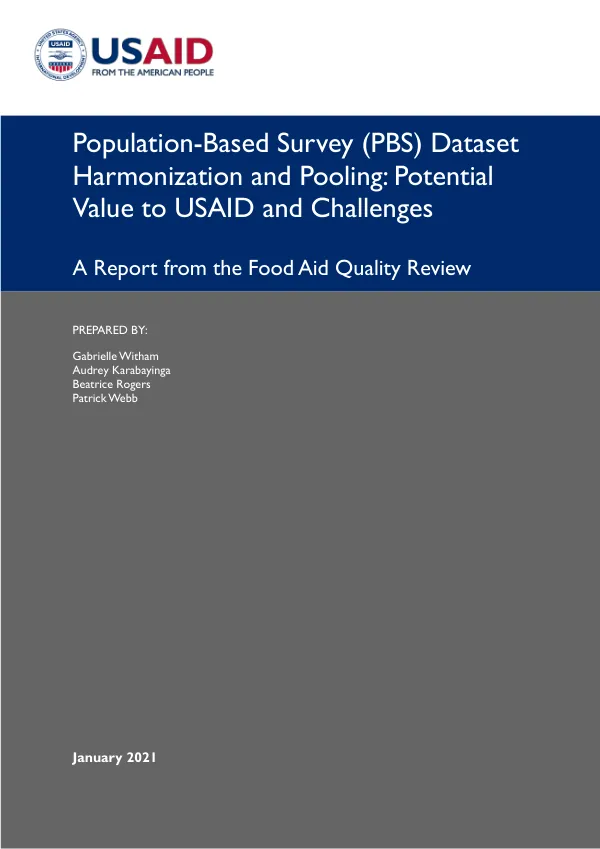
Population-Based Survey Dataset Harmonization and Pooling: Potential Value to USAID and Challenges
Sign inCATHOLIC RELIEF SERVICES ORGANIZATION
Population-Based Survey Dataset Harmonization and Pooling: Potential Value to USAID and Challenges
The Population-Based Survey (PBS) Dataset Harmonization and Pooling report was prepared by Gabrielle Witham, Audrey Karabayinga, Beatrice Rogers, and Patrick Webb in January 2021.
2021 · 52 pages
Sign in to readA free account is required to download.
Abstract
The report was made possible by the generous support of the American people through the United States Agency for International Development's Bureau for Humanitarian Assistance (USAID/BHA) and the legacy Office of Food for Peace (FFP). The report focuses on the potential value of harmonized and pooled PBS datasets to USAID and the challenges associated with this process. The authors note that the contents of the report are the responsibility of Tufts University and its partners in the Food Aid Quality Review (FAQR), and do not necessarily reflect the views of USAID or the United States Government. The report outlines the methods used to select data sources and activities, design standardized variables, and create a pooled dataset. The authors also discuss the challenges encountered during the pooling process, including geographic identifiers, z-scores, missing unique identifiers, codebook values, and missing variables needed for indicator calculations. The results section of the report presents exploratory demographic and anthropometric analyses of the pooled dataset. The authors examine the database content, including the availability of activity documents, technical sectors for development food security activities, and total mother-child unit rations. The discussion section highlights the potential use of pooled datasets for programming and research, as well as the limitations of pooled datasets. The authors recommend data and metadata standardization and reporting, and identify potential avenues for expansion of this work and further analysis. The report includes a list of acronyms, a table of contents, and annex tables that provide additional information on activity characteristics, evaluation and dataset details, and strategic objectives. The report also includes a list of tables and annex tables that provide detailed information on the pooled dataset. The report concludes that the harmonized and pooled PBS dataset has the potential to provide valuable insights for USAID programming and research. However, the authors also note that the pooling process is complex and requires careful consideration of data quality issues and challenges.
Related documents