CARANA CORPORATION, INC.
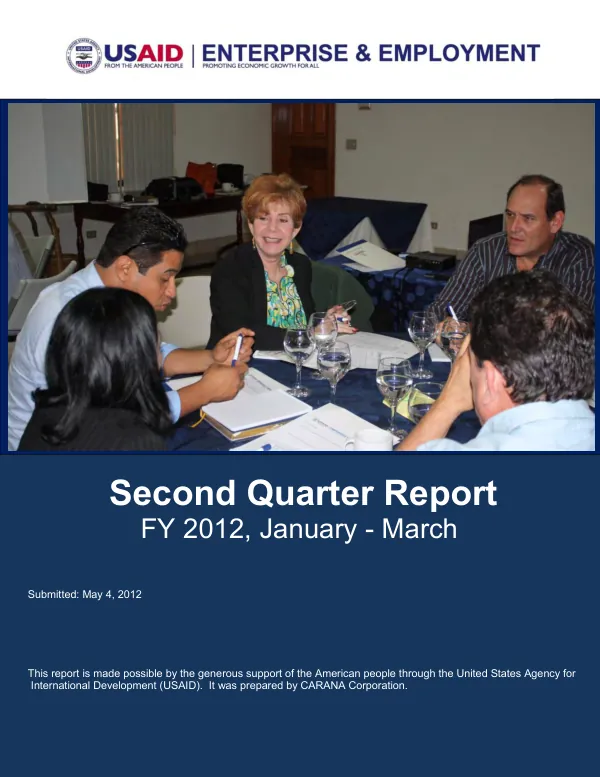
Enterprise & Employment Second Quarter Report FY 2012
The Enterprise and Employment Program in Nicaragua, supported by USAID, aimed to promote economic growth and job creation through small and medium-sized enterprise (SME) development and value chain improvement.
2012 · 31 pages
Sign in to readA free account is required to download.
Abstract
During the second quarter of FY12 (January - March 2012), CARANA Corporation, the implementing partner, achieved significant progress in various areas. SME and Value Chain Development was a key focus area, with E&E helping to generate over $1.57 million in new sales and more than 230 new jobs through anchor firm alliances. The majority of new sales and jobs were in the agriculture sector, with a significant portion occurring in food insecure areas. E&E also conceptualized a new anchor firm alliance with NICACENTRO, Nicaragua's largest dairy cooperative, which would help establish milk collection centers in remote areas of northern Nicaragua, generating over $2.5 million in new sales and creating over 300 new jobs. In addition, E&E facilitated more than $2.4 million in loans to Nicaraguan SMEs through alliances with anchor firms and formal lenders. The program exceeded its FY12 target of facilitating $5 million in loans. E&E also trained 91 Banco de Finanzas (BDF) SME clients to improve their financial management and helped BDF implement a new SME lending tool, which reduced loan analysis time by more than half. The program also made progress in supporting CAFTA-DR implementation and policy reform. The National Assembly began reviewing laws supported by E&E, including the Ports Law, the Customs Law, and the Solid Waste Management Law, which includes a chapter to provide incentives for the recycling industry. E&E also submitted the final version of the Export Product Promotion Law to COSEP, which plans to present it to the National Assembly for passage in May. Furthermore, E&E supported MARENA in completing 459 business inspections to evaluate existing residual water management practices affecting Rio San Juan and Lake Cocilbolca (Lake Nicaragua). Fifty percent of businesses inspected lacked an environmental permit, and these businesses received technical assistance to begin acquiring permits. MARENA conducted a census to determine the amount of people who will benefit from better residual water management practices, finding that 13,014 people (47% female) will benefit directly and an additional 8,550 people will benefit indirectly. E&E also reached an agreement with the Central American Bank (BAC) to assist them in developing an SME loan department and an SME loan market penetration strategy. Additionally, E&E made considerable progress in assisting the SME-focused credit bureau, SINRIESGOS, to develop a new credit scoring tool to help SME lenders make better lending decisions. In terms of human capital development, E&E helped facilitate regional training on certifications for 193 SME representatives and trained another 13 SME representatives on business planning and e-commerce. E&E also finalized its Corporate Social Responsibility (CSR) Program with uniRSE, having trained 69 SMEs to analyze their current CSR practices and develop action plans aimed at improving them. Overall, the Enterprise and Employment Program in Nicaragua made significant progress in promoting SME development and value chain improvement, supporting CAFTA-DR implementation and policy reform, and enhancing human capital development.