USAID DEC
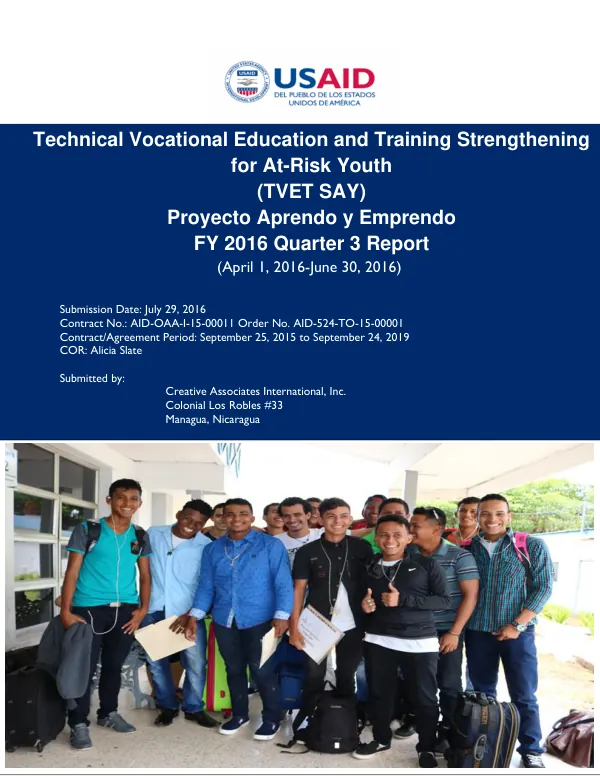
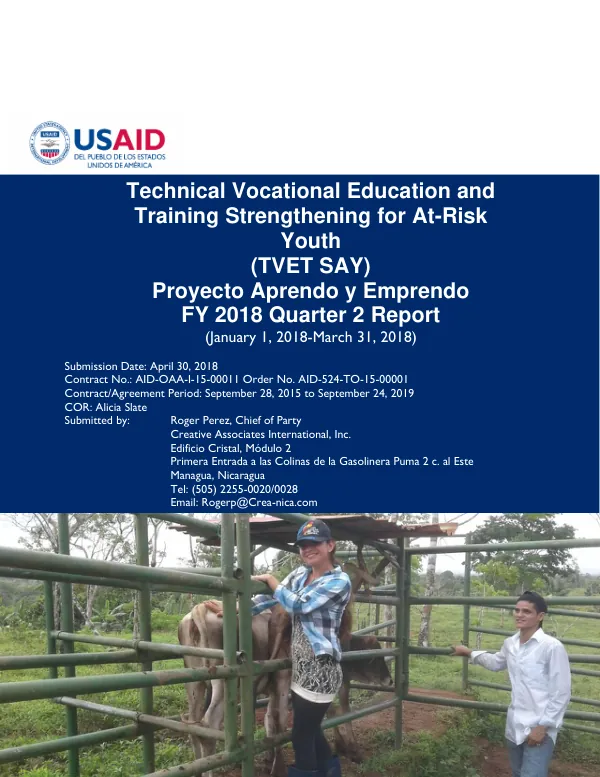
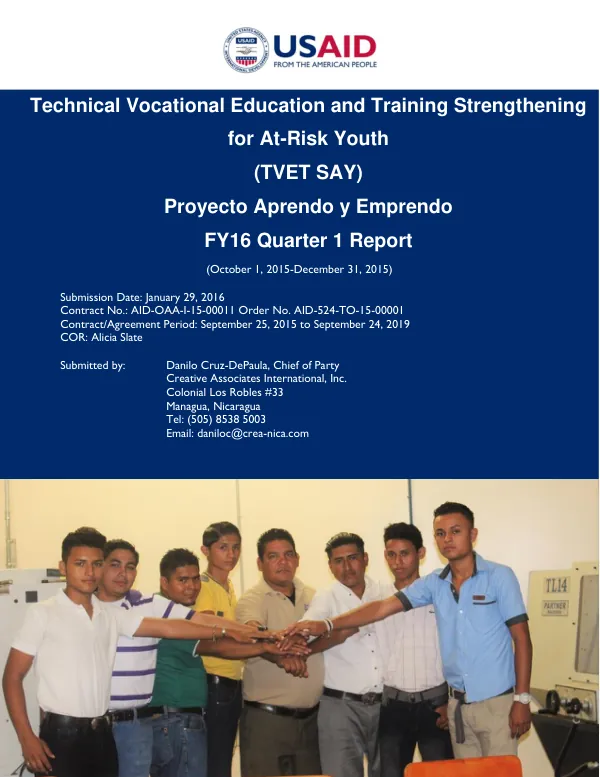
Technical Vocational Education and Training Strengthening for At-Risk Youth (TVET SAY) FY16 Quarter 1 Report
Sign inCARANA CORPORATION, INC.
Technical Vocational Education and Training Strengthening for At-Risk Youth (TVET SAY) FY16 Quarter 1 Report
The Technical Vocational Education and Training Strengthening for At-Risk Youth project (TVET SAY) is a USAID-funded initiative aimed at improving vocational education and training for at-risk youth in Nicaragua.
2016 · 14 pages
Sign in to readA free account is required to download.
Abstract
The project began in October 2015, with the arrival of the Creative Associates International team, led by Chief of Party Danilo Cruz-DePaula. The project's start-up phase was marked by rapid progress, with the establishment of a temporary office, onboarding of key personnel, and recruitment of non-key staff. The team also met with ten private technical vocational (TVET) centers, developing criteria for evaluating their ability to support the project's goals. TVET center selection criteria and a list of recommended centers were sent for USAID approval, with memoranda of understanding (MOU) to be signed in April-May 2016. The team established strategic alliances with private sector counterparts, including Simplemente-Madera-Centro Juan Pablo II, Fundación Samuel – Nicaragua Machinery Company, Comercial McGregor, Central American Fisheries, and Bluefields Indian and Caribbean University. These alliances aim to create sustainable partnerships between business enterprises, TVET centers, and the project. The team also participated in the Annual Corporate Social Responsibility Conference, sponsored by the Nicaraguan Union for Corporate Social Responsibility, and developed content for the project website and social media sites. In the Caribbean, the team met with stakeholders, including BICU, URACCAN, FADCANIC, Movimiento de la Diversidad Sexual de la RAAS, and Global Communities, to describe TVET SAY goals and request their input and feedback. The team began conceptualizing a risk assessment as a pilot program in the Caribbean, implementing Creative's Youth Services Eligibility Tool (YSET) to identify different categories of at-risk youth and enhance the project's ability to address their needs. The project's expected activities for the second quarter of FY2016 include completing registration with the Government of Nicaragua, delivering monitoring and evaluation, gender analysis, and baseline studies, signing MOUs and initiating OCAT for five TVET centers, holding the first national meeting of project TVET centers, and launching web and social media tools. The team also aims to sign at least three alliances between TVET centers and Nicaraguan businesses and prepare to implement the YSET tool in the Caribbean. The project's momentum is expected to continue in the second quarter, with a focus on implementing the project's goals and objectives. The team's progress and achievements demonstrate a strong start to the project, with a clear direction and commitment to improving vocational education and training for at-risk youth in Nicaragua.