DAI GLOBAL, LLC
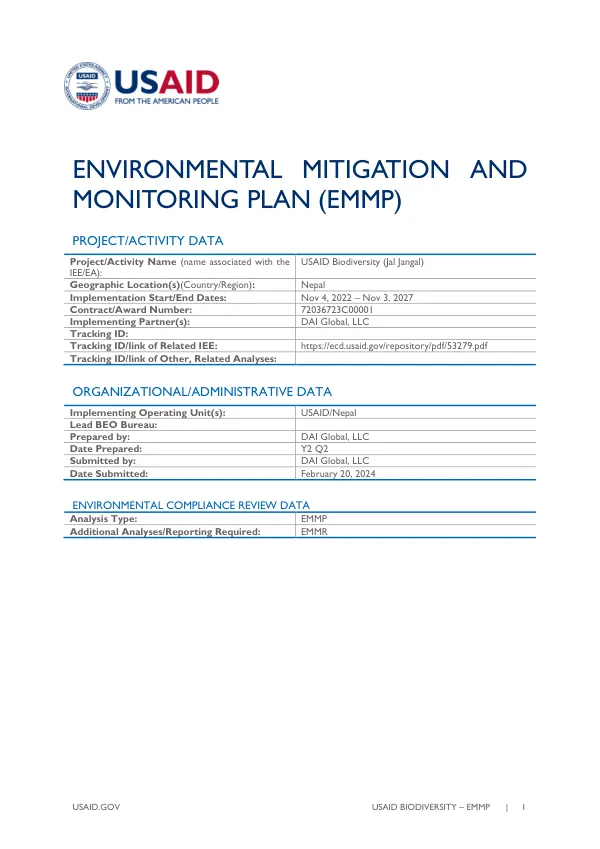
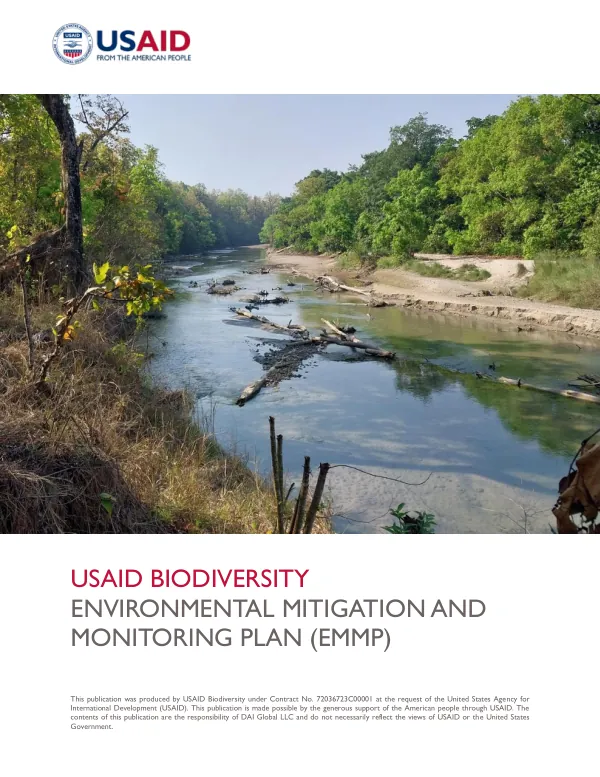
Environmental Mitigation and Monitoring Plan (EMMP) for USAID Biodiversity
USAID Biodiversity's Environmental Mitigation and Monitoring Plan (EMMP) is a tool to ensure all implemented activities are environmentally sound, and potential risks are mitigated to minimize the environmental risks to the activity area, environmental resources, ecosystem, people, and their livelihoods.
2023 · 64 pages
Sign in to readA free account is required to download.
Abstract
The EMMP provides a basis for systematic implementation of Initial Environmental Examination (IEE) conditions and serves as a vehicle for translating the broad, programmatic-level IEE conditions into specific, implementable, verifiable actions that are relevant to USAID Biodiversity. The EMMP is organized into two main sections: a screening of proposed USAID Biodiversity activities per the criteria outlined in the USAID/Nepal IEE to identify which areas of work are Categorical Exclusions (CEs) under section 216.2(c) and require no further action and which areas of work are Negative Determinations with conditions under section 216.3(a)(3) and Positive Threshold Determination per 22 CFR216.3 (2) (iii). The second section describes USAID's Environmental Mitigation, Monitoring, and Reporting requirements and procedures the activity will follow. Most of USAID Biodiversity's activities are expected to have limited direct impacts on Environmental Health and Safety (EHS). However, activities related to natural resource management, ecosystem restoration, landscape management, combating wildlife trade, natural resource safeguards, Deoxyribonucleic Acid (DNA) extraction, livelihood development and promotion, climate change adaptation, and water resource management may have a more substantial impact on EHS. For example, low-cost bio-engineering infrastructure, landslide remediation, DNA extraction, etc., are activities for which environmental impacts would be considered. The EMMP assesses the environmental impact of activities proposed in USAID Biodiversity's Year 1 Annual Work Plan, which covers the period of November 4, 2022 – September 30, 2023. The EMMP will be updated as the USAID Biodiversity team develops and implements subsequent annual work plans. USAID Biodiversity will build on past successes in Nepal's forestry and freshwater sectors to support local communities and conservation practitioners and strengthen the capacity of provincial and municipal governments, for biodiversity conservation, natural resources safeguard and management, and climate change adaptation. The activity will reduce multiple threats to ecosystems and wildlife species to conserve nature, enhance human well-being, and safeguard the future. USAID Biodiversity will achieve measurable conservation targets within the biodiversity-rich, terrestrial, and freshwater ecosystems in and around the Chitwan-Annapurna Landscape, Kailash Sacred Landscape, Terai Arc Landscape, and the proposed Karnali Conservation Landscape, while increasing resilience to climate change and contributing to the inclusive and sustainable development of the Nepali people. To accomplish this, USAID Biodiversity will implement activities aligned with three mutually interrelated and reinforcing objectives. The approach will be based on a four-pronged strategy: Partner, Empower, Integrate, and Innovate. This will involve partnering with local counterparts to lead every aspect of design, implementation, and learning to build ownership and local system capacity, empowering women, indigenous communities, and vulnerable groups to be part of decision-making, integrating across landscapes, disciplines, and government units, and innovating and adapting through evidence-based decision-making and piloting and scaling promising conservation technologies. The United States Government (USG) environmental policies and procedures are guided by the Foreign Assistance Act (FAA) of 1961, which provides development assistance in the form of technical advisory services, research, training, construction, and commodity support. USAID also conducts programs to promote environmental protection and conservation. The USG environmental policies and procedures are designed to ensure that development assistance is provided in a manner that is environmentally sound and sustainable. The Government of Nepal has its own environmental policies and procedures, which are outlined in various laws and regulations. These policies and procedures are designed to protect the environment and promote sustainable development. USAID Biodiversity will work with the Government of Nepal to ensure that its activities are consistent with these policies and procedures and to promote environmental protection and conservation in Nepal.