DAI GLOBAL, LLC
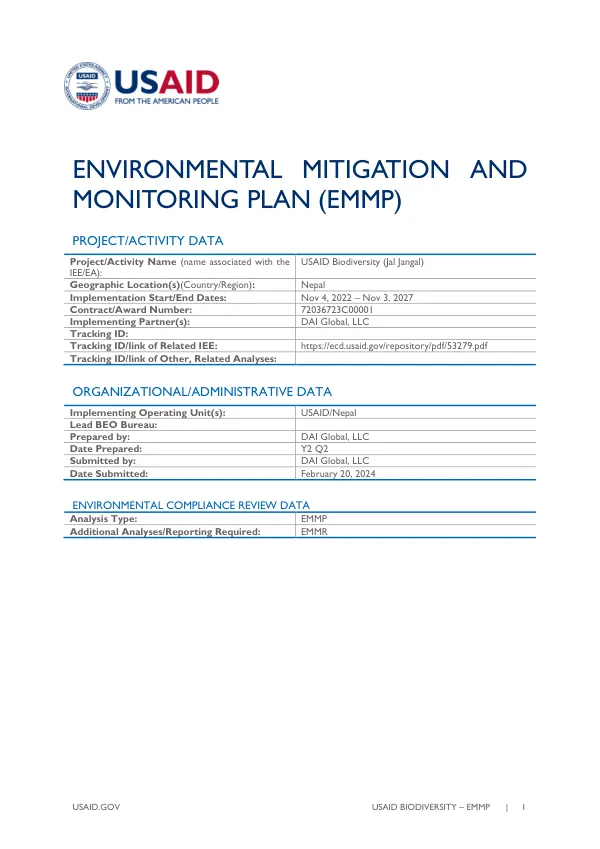
Environmental Mitigation and Monitoring Plan (EMMP) for USAID Biodiversity
The USAID Biodiversity initiative in Nepal aims to conserve and restore the country's natural resources, including forests, wetlands, and wildlife.
2024 · 44 pages
Sign in to readA free account is required to download.
Abstract
The project will focus on three main objectives: improving the health of ecosystems, strengthening environmental crime and natural resource safeguards, and enhancing climate resilience. To achieve these objectives, the project will implement activities such as establishing watershed networks and user groups, supporting research and monitoring on flagship species and ecosystems, and piloting conservation enterprises. The project will also develop handbooks and provide training on wildlife trafficking and parts identification technology. The project will be implemented in the Chitwan-Annapurna Landscape, Kailash Sacred Landscape, and the proposed Karnali Landscape. The project will work with local counterparts, empower women and indigenous communities, and integrate across landscapes and disciplines. The project will also address the impacts of climate change and promote sustainable livelihoods. The project will conduct a screening of planned activities to identify areas of work that are Categorical Exclusions (CEs) and require no further action, as well as areas of work that require Negative Determinations with Negative Determinations. The project will follow USAID's Environmental Mitigation and Monitoring Plan (EMMP) procedures prior to, during, and post-implementation. The EMMP will separate activities into two tables: one for Categorical Exclusions and another for Negative Determinations. The project will also conduct monitoring and reporting guidelines and review and reporting forms relevant to implementation. The project will work to address the impacts of climate change and promote sustainable livelihoods. The project will be implemented over a period of five years, from 2024 to 2027. The project will be implemented by DAI, a USAID implementing partner. The project will work with local counterparts, empower women and indigenous communities, and integrate across landscapes and disciplines.
Related documents