USAID DEC
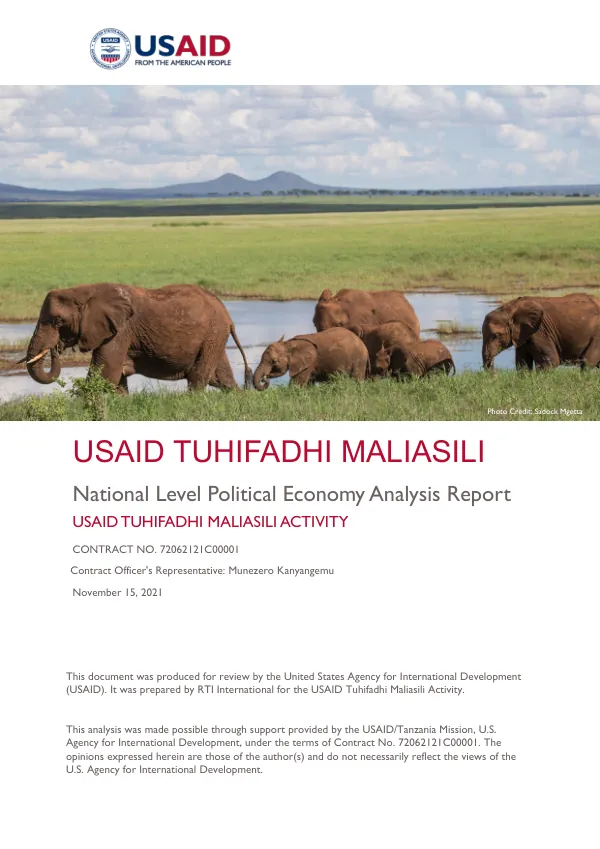
Environmental Mitigation and Monitoring Plan (EMMP) for USAID Tuhifadhi Maliasili Activity
Sign inRTI INTERNATIONAL
Environmental Mitigation and Monitoring Plan (EMMP) for USAID Tuhifadhi Maliasili Activity
The USAID Tuhifadhi Maliasili Activity is a five-year initiative aimed at addressing dynamics that hinder habitat connectivity and the long-term persistence of biodiversity in Tanzania.
2021 · 17 pages
Sign in to readA free account is required to download.
Abstract
The activity was awarded to Research Triangle Institute (RTI) International on June 4, 2021, and is implemented in collaboration with the Government of Tanzania and civil society organizations. The overall goal of the activity is to strengthen government and civil society capacity for biodiversity conservation, increase private sector engagement in conservation and Natural Resource Management (NRM), and strengthen the policy and regulatory framework for conservation and NRM. The activity focuses on six key areas of connectivity, including the Kwakuchinja Wildlife Corridor, Tarangire-Simanjiro Plains, Kigosi Moyowosi-Uvinza corridor, Nyerere Selous-Udzungwa corridor, Amani-Nilo Corridor, and Pemba Channel Conservation Area (PECCA). These areas are critical for maintaining habitat connectivity and biodiversity in Tanzania. The activity will support community conservation enterprises (CCEs) in these areas, which provide sustainable financing to conservation activities while providing long-term economic and financial resilience to communities adjacent to protected areas. The activity will implement several mitigation measures to address potential adverse impacts associated with beekeeping, including depletion of natural resources, forest fires, introduction of exotic species and disease, and loss of biodiversity. These measures include introducing preventive conservation measures, adhering to regulations, conducting on-site spot checks, and maintaining best practices to prevent colony losses and declines in local bee populations. The activity will also refer to the FAO Sustainable Forest Management (SFM) Toolbox: Bees and their role in forest livelihoods to inform its approach. The activity will prepare an Environmental Mitigation and Monitoring Report (EMMR) annually to summarize the effectiveness of mitigation measures, issues encountered, resolutions, and lessons learned. The report will be submitted to the Activity Manager/AOR/COR and the USAID Environmental Compliance Database. The activity will also conduct field monitoring and reporting to ensure that mitigation measures are implemented effectively and that any issues or concerns are addressed promptly. The USAID Tuhifadhi Maliasili Activity will leverage initiatives by private sector actors to support CCEs, such as beekeeping, handicraft products, and other ancillary services required to support the tourism value chain. The activity will also support and leverage initiatives by private sector actors to support such CCEs, such as beekeeping, handicraft products, and other ancillary services required to support the tourism value chain. The activity will implement action no. 5.4.1 and 5.4.2 of the Tanzania Wildlife Corridor Assessment, Prioritization, and Action Plan (TWCAPAP). The activity will prioritize projects aiming to reconcile conservation and community development to improve income of community members, enhance their resilience, and secure targeted species and their habitats in areas of connectivity. The activity will also support and leverage initiatives by private sector actors to support such CCEs, such as beekeeping, handicraft products, and other ancillary services required to support the tourism value chain. The activity will implement action no. 5.4.1 and 5.4.2 of the Tanzania Wildlife Corridor Assessment, Prioritization, and Action Plan (TWCAPAP). The USAID Tuhifadhi Maliasili Activity will maintain a database of CCEs supported by the activity, including information on the number of people and loans leveraged, as well as the types of projects supported. The activity will also conduct regular monitoring and evaluation to assess the effectiveness of its interventions and make adjustments as needed. The activity will also refer to the FAO Sustainable Forest Management (SFM) Toolbox: Bees and their role in forest livelihoods to inform its approach. The activity will also support and leverage initiatives by private sector actors to support such CCEs, such as beekeeping, handicraft products, and other ancillary services required to support the tourism value