AVSI FOUNDATION
Environmental Status Report (ESR) FY2023
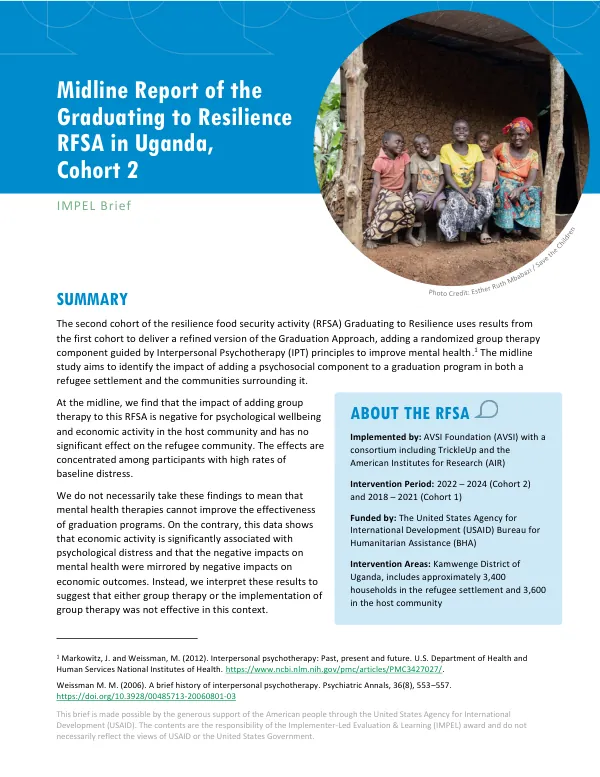
The Graduating to Resilience Activity is a Resilience Food Security Activity (RFSA) led by AVSI Foundation, together with consortium partners Trickle Up and American Institutes for Research (AIR), implemented in four sub counties – Biguli, Bihanga, Bwizi, and Nkoma and 3 town councils (TC) - Nkoma-Katalyeba TC, Lyakahungu TC, and Biguli TC of Kamwenge district in Uganda.
2023 · 39 pages
Sign in to readA free account is required to download.
Abstract
The Activity is in its 6th year of implementation with 6,852 active households. During the reporting period, Cohort II participants received trainings in Village Savings and Loans Association (VSLA) methodology, business selection, planning and management (SPM), financial literacy (FL), and experiential learning in the Farmer Field Business School (FFBS). The Activity's geographic location is Africa, Uganda, Kamwenge District, with an implementation start date of October 1, 2017, and an end date of September 30, 2024. The Activity has a total budget of $36,700,000, with AVSI Foundation, Trickle Up, and American Institutes for Research (AIR) as implementing partners. The Activity's environmental compliance report describes the progress in implementing required environmental safeguards and mitigation strategies, including climate risk management, for FY2022, in compliance with USAID environmental regulations (22 CFR 216) and Uganda Government environmental regulations. The Activity's environmental compliance report also presents the budget for achieving compliance in the next year of implementation (FY2024). The report includes management plans: Integrated Production and Pest Management, Climate Risk Management Plan, and the Pesticide Safer Use Action Plan. The Activity has made significant progress in implementing the required environmental safeguards and mitigation strategies, including climate risk management. The report highlights the Activity's efforts to promote sustainable land management, conservation of wetlands, and safer use of pesticides. The Activity has also made significant progress in promoting climate risk management, with a focus on reducing the vulnerability of households to climate-related shocks and stresses. The report highlights the Activity's efforts to integrate climate risk management into the Activity's performance monitoring and evaluation (M&E) systems. The Activity has also made significant progress in promoting sustainable use and management of wetlands and riverbanks, with a focus on reducing the impact of human activities on the environment. The Activity's environmental compliance report is a critical component of the Activity's overall reporting requirements, and it provides a comprehensive overview of the Activity's progress in implementing required environmental safeguards and mitigation strategies. The report highlights the Activity's efforts to promote sustainable land management, conservation of wetlands, and safer use of pesticides, as well as its efforts to promote climate risk management and sustainable use and management of wetlands and riverbanks. The Activity's environmental compliance report is a key document that provides stakeholders with information on the Activity's progress in implementing required environmental safeguards and mitigation strategies. The report highlights the Activity's efforts to promote sustainable land management, conservation of wetlands, and safer use of pesticides, as well as its efforts to promote climate risk management and sustainable use and management of wetlands and riverbanks. The report provides a comprehensive overview of the Activity's progress and highlights the importance of continued support for the Activity's environmental efforts.
Related documents