FHI 360
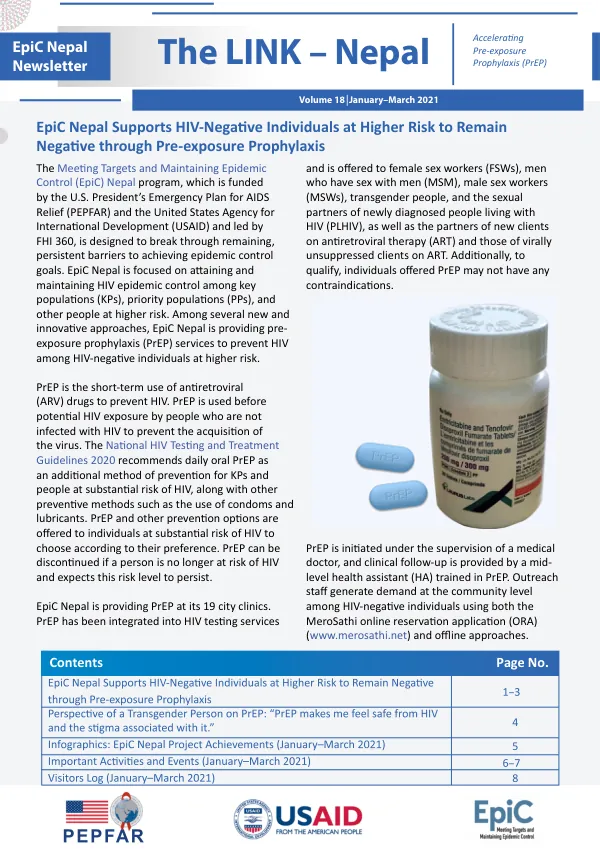
EpiC Nepal Newsletter Volume 18 January–March 2021
The Meeting Targets and Maintaining Epidemic Control (EpiC) Nepal program is a project designed to break through remaining barriers to achieving epidemic control goals.
2021 · 8 pages
Sign in to readA free account is required to download.
Abstract
Funded by the U.S. President's Emergency Plan for AIDS Relief (PEPFAR) and the United States Agency for International Development (USAID), and led by FHI 360, EpiC Nepal focuses on attaining and maintaining HIV epidemic control among key populations (KPs), priority populations (PPs), and other people at higher risk. Among several new and innovative approaches, EpiC Nepal is providing pre-exposure prophylaxis (PrEP) services to prevent HIV among HIV-negative individuals at higher risk. PrEP is the short-term use of antiretroviral (ARV) drugs to prevent HIV. It is used before potential HIV exposure by people who are not infected with HIV to prevent the acquisition of the virus. The National HIV Testing and Treatment Guidelines 2020 recommends daily oral PrEP as an additional method of prevention for KPs and people at substantial risk of HIV, along with other preventive methods such as the use of condoms and lubricants. PrEP and other prevention options are offered to individuals at substantial risk of HIV to choose according to their preference. PrEP can be discontinued if a person is no longer at risk of HIV and expects this risk level to persist. EpiC Nepal is providing PrEP at its 19 city clinics. PrEP has been integrated into HIV testing services and is offered to female sex workers (FSWs), men who have sex with men (MSM), male sex workers (MSWs), transgender people, and the sexual partners of newly diagnosed people living with HIV (PLHIV), as well as the partners of new clients on antiretroviral therapy (ART) and those of virally unsuppressed clients on ART. Additionally, to qualify, individuals offered PrEP may not have any contraindications. PrEP is initiated under the supervision of a medical doctor, and clinical follow-up is provided by a mid-level health assistant (HA) trained in PrEP. In March 2021, EpiC Nepal initiated a campaign to increase PrEP uptake among beneficiaries at risk of HIV infection. The target was to initiate PrEP among at least 1,500 individuals by the end of March. PrEP campaign creative events resulted in increased uptake of PrEP. In addition to providing PrEP-related information, they screen clients for PrEP, provide referral and follow-up for PrEP clients in the community, and support adherence and continuation. EpiC Nepal is implementing micro-targeting approaches for HIV-negative individuals at higher risk, including staff capacity building, community monitoring, and demand-generation activities such as the mobilization of PrEP champions. EpiC Nepal regularly reviews data to monitor progress, identify challenges, and identify continuous improvement opportunities. At the beginning of the fiscal year (FY21), Nepal encountered challenges for initiating PrEP mainly due to the short supply of PrEP drugs. When the supply issue was resolved in November 2020, PrEP was aggressively scaled up. A targeted campaign was conducted in March 2021. As a result, in the first semi-annual (SA) period of FY21, the 19 EpiC Nepal-supported facilities newly initiated 1,869 individuals on PrEP. Of those, 767 (41%) were FSWs, 603 (32%) were MSM, 404 (22%) were transgender people, and the remaining 95 (5%) were other individuals at higher risk.