AVENIR HEALTH
Requirement for Reaching HIV Targets in Nepal
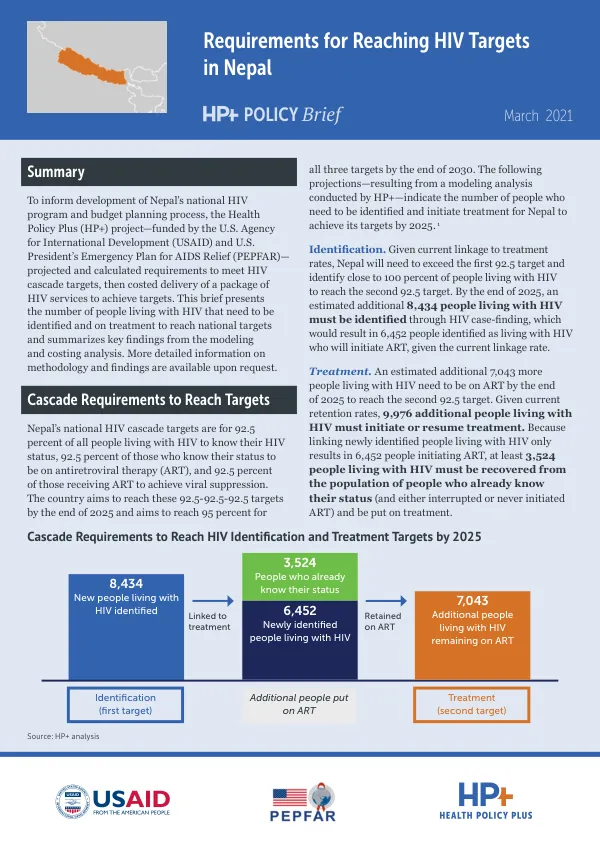
Nepal's national HIV program aims to reach 92.5 percent of all people living with HIV who know their status, 92.5 percent of those who know their status who are on antiretroviral therapy (ART), and 92.5 percent of those receiving ART who achieve viral suppression by the end of 2025.
2021 · 2 pages
Sign in to readA free account is required to download.
Abstract
The country also aims to reach 95 percent for all three targets by the end of 2030. To achieve these targets, an estimated 8,434 people living with HIV must be identified through HIV case-finding by the end of 2025. This would result in 6,452 people identified as living with HIV who will initiate ART, given the current linkage rate. An additional 7,043 people living with HIV need to be on ART by the end of 2025 to reach the second 92.5 target. Given current retention rates, 9,976 additional people living with HIV must initiate or resume treatment. Reaching the 2025 targets will require a focus on people living with HIV who know their status but either interrupted or never initiated treatment, in addition to identifying new people living with HIV and linking them to treatment. If linkage to treatment and/or retention rates improve, fewer people living with HIV will need to be recovered from the population who already know their status over time, which may save costs. These cascade targets assume prevention interventions are scaled up along with identification and treatment interventions. Reaching the male labor migrant population, in addition to other high-risk populations, in Nepal is necessary to reach HIV targets. Most new HIV infections come from outside Nepal. Male labor migrants with HIV must be identified and put on ART to reach national targets. However, due to geographic dispersion and high mobility among this population, innovative prevention, case-finding, and treatment enrollment strategies need to be implemented to effectively reach the population and reduce HIV transmission. Scaling up more efficient case-finding, such as community-led testing with risk assessment and index testing, would lower the overall HIV program budget while still meeting required cascade identification targets. Nepal will experience a large gap in resource requirements to reach HIV program targets. If overall domestic health spending on HIV as a proportion of domestic health spending and donor funding for HIV remains relatively constant, Nepal will still require additional funding to reach HIV program targets. For Nepal to work toward covering the costs of HIV programming, overall health spending will need to increase as well as the proportion of the health budget being allocated to HIV.