USAID
Estableciendo un Programa de Monitoreo de Calidad de Medicina en el Perú
The Promoting the Quality of Medicines (PQM) program conducted a study in 2011 on the quality of emergency obstetric and newborn medicines in public primary care centers in Santa Rosa, Guatemala.
2013 · 38 pages
Sign in to readA free account is required to download.
Abstract
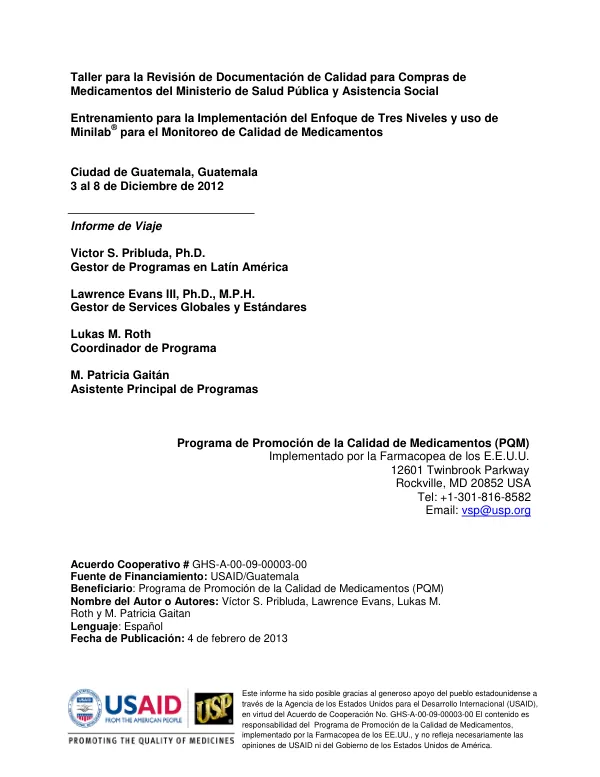
The study identified several failed products and revealed many gaps in quality assurance and quality control processes during procurement of medicines by the Ministry of Health (Ministerio de Salud Pública y Asistencia Social, MSPAS). In response to these findings, PQM planned two activities: a workshop to review quality documentation for purchases made by the MSPAS and a training on the implementation of the three-level approach and use of Minilab for medicines quality monitoring. The workshop was attended by representatives of relevant dependencies of the MSPAS involved in regulation, procurement, distribution, and analysis of medicines utilized in the public sector. These included the Medicine Regulatory Authority (Departamento Regulación y Control de Productos Farmacéuticos y Afines, DRCPFA), the Logistic Unit for Pharmaceutical Technical Assistance to Regional Health Districts, the Vice-ministry for Hospitals, Regional Health Offices (Direcciones de Areas de Salud, DAS), Regional Hospitals, and the National Health Laboratory (Laboratorio Nacional de Salud, LNS), whose Unit of Medicines (UM) is the Official Medicine Control Laboratory (OMCL) in Guatemala. During the workshop, quality control processes in place were reviewed, and several changes were suggested to ensure that the information on the quality of medicines provided by manufacturers/distributors is complete and reliable, and that quality control throughout procurement and distribution is performed through standardized processes by the relevant stakeholders. The training on the implementation of the three-level approach introduced the concept of cost-effective, reliable, and sustainable methodologies for Medicines Quality Monitoring (MQM). Selected personnel from the DAS, Vice-ministry of Hospitals, and UM-LNS were instructed in analytical tests utilizing the portable laboratory Minilab. Next steps agreed upon will help implement decentralized MQM activities coordinated by central and regional sanitary authorities. PQM also held meetings with the USAID mission, the UM-LNS, and the General Office for Health Regulation, Vigilance, and Control (Dirección General de Regulación, Vigilancia y Control de la Salud, DGRVCS). PQM debriefed USAID officials and the Director of the DGRVCS on recent activities performed in Guatemala and on those planned for FY2013, and provided a brief summary of the topics discussed during the workshop and training held that week. At the meeting with the UM-LNS, PQM received an update on recent corrective actions implemented at the lab and discussed the programming of FY2013 activities. The PQM program is implemented by the United States Pharmacopeia (USP) and is funded by USAID/Guatemala through the Cooperative Agreement # GHS-A-00-09-00003-00. The program aims to promote the quality of medicines in Guatemala and improve the health of the population by ensuring the availability of safe and effective medicines. The workshop and training activities were attended by representatives of the MSPAS and other relevant stakeholders, including the DRCPFA, the Logistic Unit for Pharmaceutical Technical Assistance to Regional Health Districts, the Vice-ministry for Hospitals, the DAS, Regional Hospitals, and the UM-LNS. The activities were designed to improve the quality of medicines in Guatemala by introducing standardized processes for quality control and monitoring, and by providing training on the use of Minilab for analytical tests. The PQM program has a long history of working with the MSPAS to improve the quality of medicines in Guatemala. The program has conducted several studies and provided training and technical assistance to the MSPAS and other stakeholders to improve the quality of medicines. The program has also worked with the USAID mission and other partners to support the implementation of the three-level approach and the use of Minilab for medicines quality monitoring. The PQM program has made significant progress in improving the quality of medicines in Guatemala. The program has identified several failed products and revealed many gaps in quality assurance and quality control processes during procurement of medicines by the MSPAS. The program has also introduced standardized processes for quality control and monitoring, and has provided training on the use of Minilab for analytical tests. The PQM program has a strong commitment to improving the quality of medicines in Guatemala and has made significant progress in achieving this goal. The program will continue to work with the MSPAS and other stakeholders to improve the quality of medicines and ensure the availability of safe and effective medicines for the population.
Related documents