USAID DEC
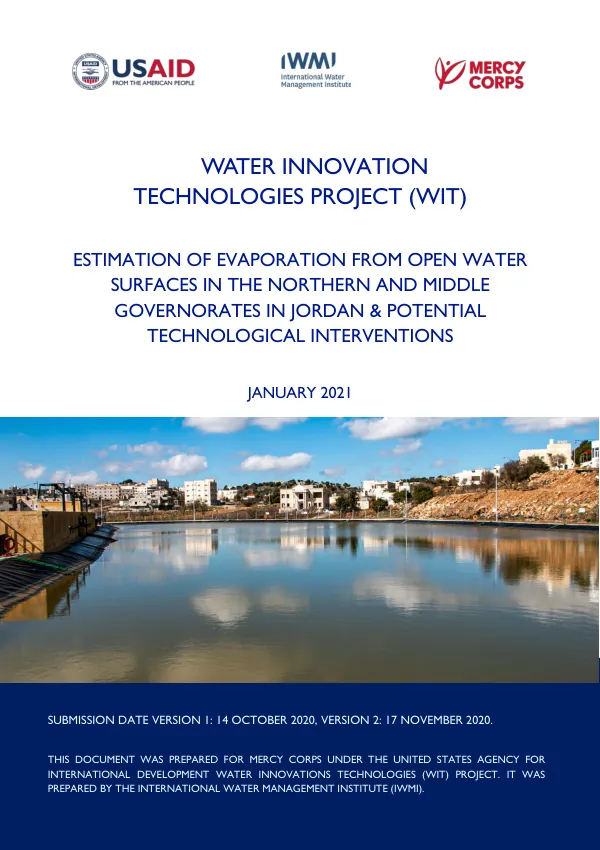
Estimation of Evaporation from Open Water Surfaces in the Northern and Middle Governorates in Jordan & Potential Technological Interventions
Sign inMERCY CORPS INTERNATIONAL
Estimation of Evaporation from Open Water Surfaces in the Northern and Middle Governorates in Jordan & Potential Technological Interventions
The agricultural development initiative in Jordan began with the estimation of evaporation from open water surfaces in the Northern and Middle Governorates.
2021 · 510 pages
Sign in to readA free account is required to download.
Abstract
Initial assessments conducted in the region identified high evaporation rates as a primary challenge. Gross evaporation in the study area increases gradually from north to south and reaches its maximum in summer, with values ranging from 34 mm in January to 123 mm in July. Implementation focused on reducing evaporation from open water surfaces storages/reservoirs using physical and natural methods. Two physical solutions were identified as available in the local market: shade-balls and hexagonal floating covers. Both technologies can provide coverage of up to 99% and reduce evaporation from open water surfaces by up to 95%. A quick cost-savings analysis conducted for Queen Rania Pond indicated that the hexagonal floating covers cost less than the shade-balls per cubic meter of potential water saved due to their higher efficiency and longer lifetime. Community feedback indicated strong adoption of evaporation reduction methodologies, with a rapid market scan of technologies available in Jordan and local providers. The report provides a review of popular methodologies used worldwide to control evaporation from open water surfaces, including websites of international providers of these technologies. A general methodology to conduct a cost-savings analysis (CSA) of different technologies is also presented, with a case study on one of the WIT communal projects. The results of the study indicate that net evaporation in the study area increases gradually from north to south and is maximum in summer. The values of minimum of mean monthly net evaporation vary from -81 mm in December to 124 mm in July. The values of maximum of mean monthly net evaporation vary from 41 mm in January to 159 mm in July. To address the issue of high evaporation rates, the report recommends the implementation of evaporation reduction methodologies, including the use of shade-balls and hexagonal floating covers. Jordan is a Middle Eastern country located between latitudes 29°N and 34°N and longitudes 34°E and 40°E, occupying an area of about 88,780 km2. The country holds a population of about 10.6 million. Administratively, Jordan is divided into three regions and 12 governorates, with the north region including Irbid, Ajloun, Jerash, and Mafraq governorates, the middle region including Balqa, Amman, Zarqa, and Madaba governorates, and the south region including Karak, Tafilah, Ma’an, and Aqaba governorates. Physiographically, Jordan is divided into three main regions, with the first region comprising a range of mountains with elevations reaching 1,812 m above mean sea level and running from north to south. The country's climate is characterized as arid and semi-arid, with high evaporation rates from water reservoirs. In Jordan, losses from evaporation were reported to be 91.8% of the total annual rainfall in 2014-2015, equivalent to 8,154 Mm3. The report aims to provide a comprehensive understanding of evaporation from open water surfaces in the Northern and Middle Governorates in Jordan and to identify potential technological interventions to reduce evaporation and provide more water for communal use.