USAID DEC
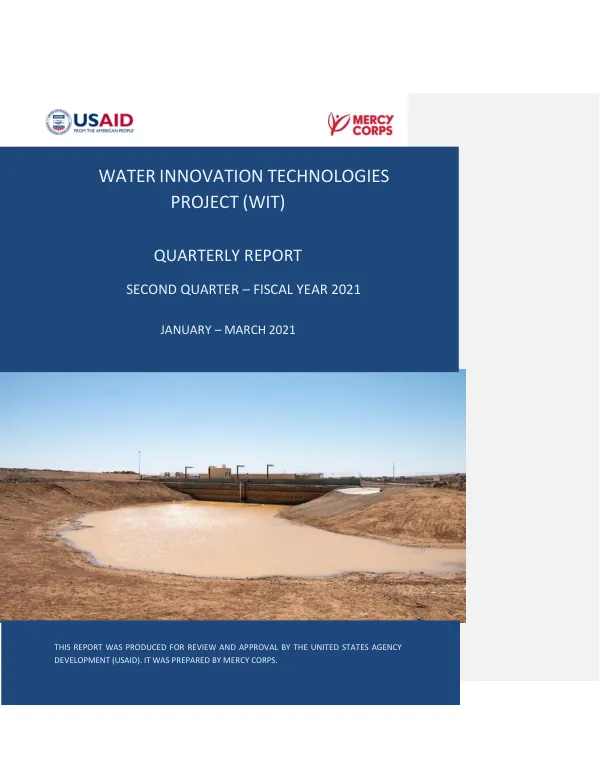
Water Innovation Technologies Project (WIT) Quarterly Report: Second Quarter - Fiscal Year 2021
Sign inGOVERNMENT OF JORDAN
Water Innovation Technologies Project (WIT) Quarterly Report: Second Quarter - Fiscal Year 2021
The Water Innovation Technologies (WIT) Project is a five-year initiative funded by the United States Agency for International Development (USAID) and implemented by Mercy Corps (MC).
2021 · 63 pages
Sign in to readA free account is required to download.
Abstract
The project's objective is to increase water conservation in Jordan by focusing on water efficiency in the agricultural sector and at the community and household levels. The project's theory of change states that if barriers to the adoption of water-saving technologies are systematically broken down at multiple levels, with different groups of water users and market actors through enhancing knowledge, forming partnerships, and providing advisory services, in addition to improving access to finance and strengthening institutions that support water-saving, then adoption of water-saving technologies by farmers, households, and communities will increase, leading to the sustainable management of water and natural resources. The project goal is to save 18.5 million cubic meters (MCM) of water by addressing market system constraints in the adoption of innovative water-saving technologies in the agriculture and household sectors. WIT works to facilitate the uptake of advisory and financing services and uses an integrated strategy with a social and behavioral change approach to help a variety of water sector market actors overcome key barriers and constraints at individual and institutional levels. For the agriculture and household sectors, lack of knowledge, information, and access to appropriate financing services are key constraints in the adoption of water-saving technologies. Through private companies, WIT promotes the sustainable and scaled adoption of water-saving practices and technologies in agriculture, households, and key market actors who work directly with farmers and communities in the North of Jordan. WIT works in collaboration with the Government of Jordan (GOJ) through the Ministry of Water and Irrigation (MWI), Jordan Valley Authority (JVA), and Water Authority of Jordan (WAJ), and the Ministry of Social Development (MoSD), along with other partners including the International Center for Biosaline Agriculture (ICBA) in the provision of technical advisory services to farmers and suppliers, the International Water Management Institute (IWMI) in the implementation of the learning agenda and monitoring of water-savings for the project, the Jordan River Foundation (JRF) in increasing the adoption of water-saving technologies by households and communities, and the Royal Scientific Society (RSS) bringing first-hand information about how communities in Jordan are innovating and adapting water-saving technologies. During the second quarter of Fiscal Year 2021 (January to March 2021), WIT continued to support market actors in increasing the adoption of water-saving technologies by farmers and households. As a result of WIT's various project activities, including demonstration sites, investment fund (IF), and results-based service package activities, 101.2 additional hectares (1,012 dunums) adopted an improved irrigation system. Within the results-based service package, agriculture suppliers optimized 74.4 hectares (744 dunums) and saved a total amount of 78,650.03 cubic meters of water, helping to scale up improved irrigation-related services. This brings the cumulative total in agriculture interventions to 1,138 hectares (11,380 dunums). The project's activities aim to inform farmers and households about the financial, environmental, and access-related benefits of water-saving technologies, building market demand for related goods and services, and build the capacity of market actors to design, distribute, promote, and finance water-saving technologies, improving the supply and affordability of related goods and services. The project's progress is being monitored and evaluated through a set of indicators, including the number of farmers that converted or adopted improved water-saving technologies and/or practices, the number of people who use financial services for water-saving technology adoption, and the number of people reached through different social behavior change campaigns. WIT's collaboration with the Government of Jordan and other partners has facilitated the provision of technical advisory services to farmers and suppliers, the implementation of the learning agenda and monitoring of water-savings for the project, and the increase of the adoption of water-saving technologies by households and communities. The project's activities have also helped to scale up improved irrigation-related services, resulting in the adoption of improved irrigation systems by 101.2 additional hectares (1,012 dunums) and the saving of a total amount of 78,650.03 cubic meters of water.