USAID DEC
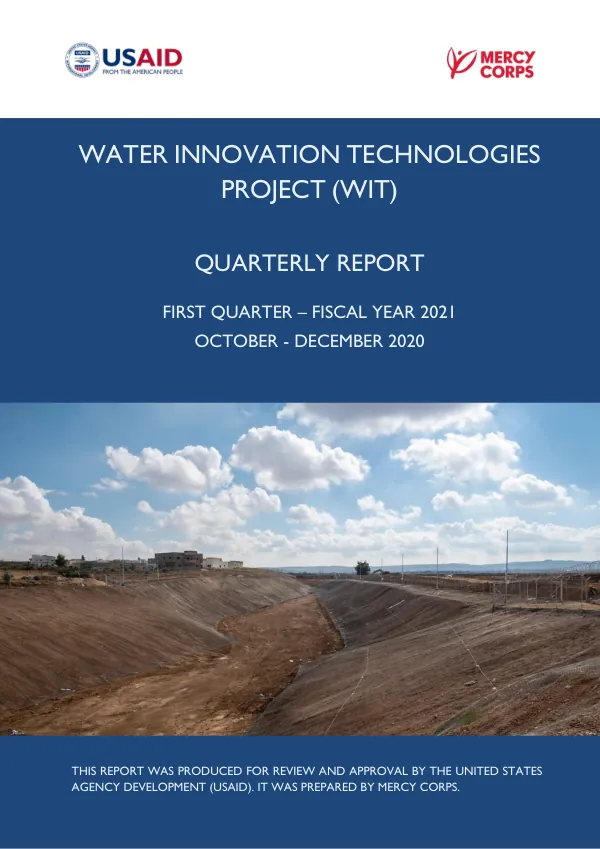
Water Innovation Technologies Project (WIT) Quarterly Report - First Quarter: Fiscal Year 2021
Sign inGOVERNMENT OF JORDAN
Water Innovation Technologies Project (WIT) Quarterly Report - First Quarter: Fiscal Year 2021
The Water Innovation Technologies Project (WIT) is a five-year initiative funded by the United States Agency for International Development (USAID) and implemented by Mercy Corps.
2021 · 46 pages
Sign in to readA free account is required to download.
Abstract
The project's objective is to increase water conservation in Jordan by focusing on water efficiency in the agricultural sector and at the community and household levels. The project's theory of change states that if barriers to the adoption of water-saving technologies are systematically broken down at multiple levels, with different groups of water users and market actors, adoption of water-saving technologies by farmers, households, and communities will increase, leading to the sustainable management of water and natural resources. The project goal is to save 18.5 million cubic meters (MCM) of water by addressing market system constraints in the adoption of innovative water-saving technologies in the agriculture and household sectors. WIT works to facilitate the uptake of advisory and financing services and uses an integrated strategy with a social and behavioral change approach to help a variety of water sector market actors overcome key barriers and constraints at individual and institutional levels. For the agriculture and household sectors, lack of knowledge, information, and access to appropriate financing services are key constraints in the adoption of water-saving technologies. Through private companies, WIT promotes the sustainable and scaled adoption of water-saving practices and technologies in agriculture, households, and key market actors who work directly with farmers and communities in the North of Jordan. WIT works in collaboration with the Government of Jordan (GOJ) through the Ministry of Water and Irrigation, Jordan Valley Authority, and Water Authority of Jordan, and the Ministry of Social Development, along with other partners, including the International Center for Biosaline Agriculture (ICBA), the International Water Management Institute (IWMI), the Jordan River Foundation (JRF), and the Royal Scientific Society (RSS). The project's activities are designed to bring improved and affordable water-saving practices and technologies into use among farmers, households, and communities, which also enhance the functioning of institutions that support water-saving. WIT has identified a set of pre-identified market barriers to frame program objectives, including lack of knowledge, information, and access to appropriate financing services. The project's activities aim to address these barriers and facilitate the adoption of water-saving technologies by farmers, households, and communities. In the first quarter of fiscal year 2021, WIT made significant progress in promoting the adoption of water-saving technologies in the agriculture and household sectors. The project's activities included promoting water-saving technologies and irrigation services for farmers, facilitating irrigation-specific financial solutions to encourage farmers to adopt water-saving irrigation technologies, and increasing awareness of water-saving technologies for households and institutions. The project also facilitated financial solutions for households to adopt water-saving technologies and made water-saving technologies available to households and communities. The project's progress was monitored and evaluated through a set of indicators, including the number of market actors that offer new technologies, products, or services, the number of formal partnerships established among private sector, civil society, or government actors, and the number of farmers that receive advisory services. The project's progress was also evaluated through a midterm evaluation, which revealed a 27% increase in household income among program participants compared to the control group. The project's progress was also evaluated through a set of indicators related to gender, including the percentage of female participants in USAID-assisted programs designed to increase access to productive economic resources. Overall, the Water Innovation Technologies Project (WIT) is making significant progress in promoting the adoption of water-saving technologies in the agriculture and household sectors in Jordan. The project's activities are designed to address key barriers to the adoption of water-saving technologies and facilitate the adoption of water-saving technologies by farmers, households, and communities. The project's progress is being monitored and evaluated through a set of indicators, and the project's impact is expected to be significant in terms of water conservation and sustainable management of water and natural resources.