MANAGEMENT SYSTEMS INTERNATIONAL
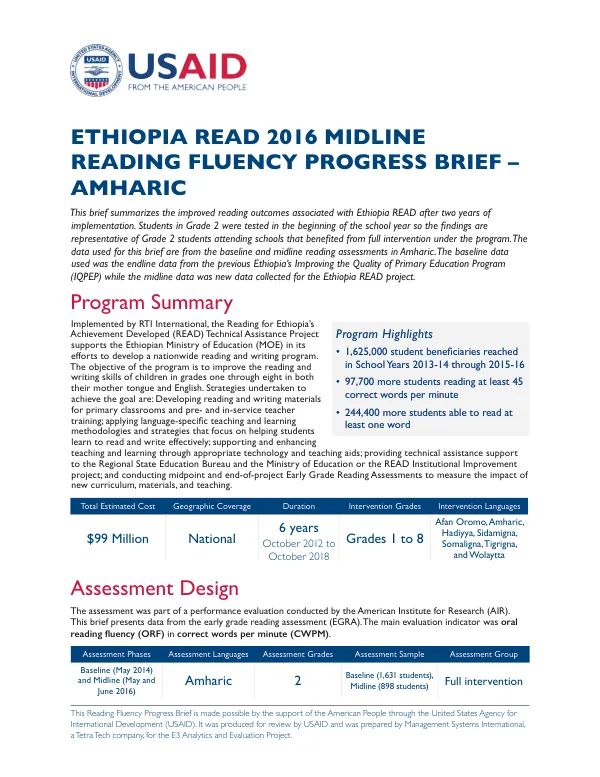
Ethiopia READ 2016 Midline Reading Fluency Progress Brief – Afan Oromo
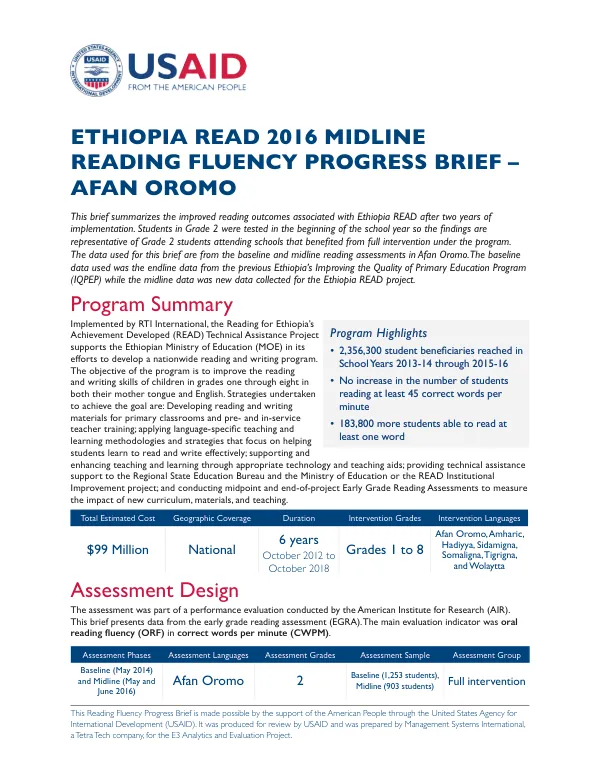
The Reading for Ethiopia's Achievement Developed (READ) Technical Assistance Project supports the Ethiopian Ministry of Education in its efforts to develop a nationwide reading and writing program.
2016 · 4 pages
Sign in to readA free account is required to download.
Abstract
Implemented by RTI International, the program aims to improve the reading and writing skills of children in grades one through eight in both their mother tongue and English. Strategies undertaken to achieve the goal include developing reading and writing materials for primary classrooms and pre- and in-service teacher training. The program focuses on language-specific teaching and learning methodologies and strategies that help students learn to read and write effectively. It also supports and enhances teaching and learning through appropriate technology and teaching aids. Additionally, the program provides technical assistance support to the Regional State Education Bureau and the Ministry of Education or the READ Institutional Improvement project. Conducting midpoint and end-of-project Early Grade Reading Assessments is also a key component of the program to measure the impact of new curriculum, materials, and teaching. The program has reached 2,356,300 student beneficiaries in School Years 2013-14 through 2015-16. However, there has been no increase in the number of students reading at least 45 correct words per minute. On the other hand, 183,800 more students are able to read at least one word. The total estimated cost of the program is $99 million, and it has a national geographic coverage. The program duration is six years, from October 2012 to October 2018, and it targets grades 1 to 8. The assessment design for the program includes a performance evaluation conducted by the American Institute for Research (AIR). The main evaluation indicator is oral reading fluency (ORF) in correct words per minute (CWPM). The assessment phases include baseline (May 2014) and midline (May and June 2016). The assessment languages are Afan Oromo, and the assessment grades are 2. The assessment sample includes 1,253 students at baseline and 903 students at midline. The assessment group is full intervention. The reading distribution shows that the percentage of students by oral reading fluency in CWPM is as follows: 0 CWPM (non-readers), a range from 1 to 60 CWPM in increments of 10 CWPM, and more than 60 CWPM (fluent readers). The reading ability levels are categorized into four generic performance categories based on ORF: 0 CWPM (non-readers), 1 to 10 CWPM, 11 to 44 CWPM, and 45 or more CWPM. The average oral reading fluency in CWPM decreased overall and for males by 2 and 5 CWPM, respectively, and increased for females by 1 CWPM.