MANAGEMENT SYSTEMS INTERNATIONAL
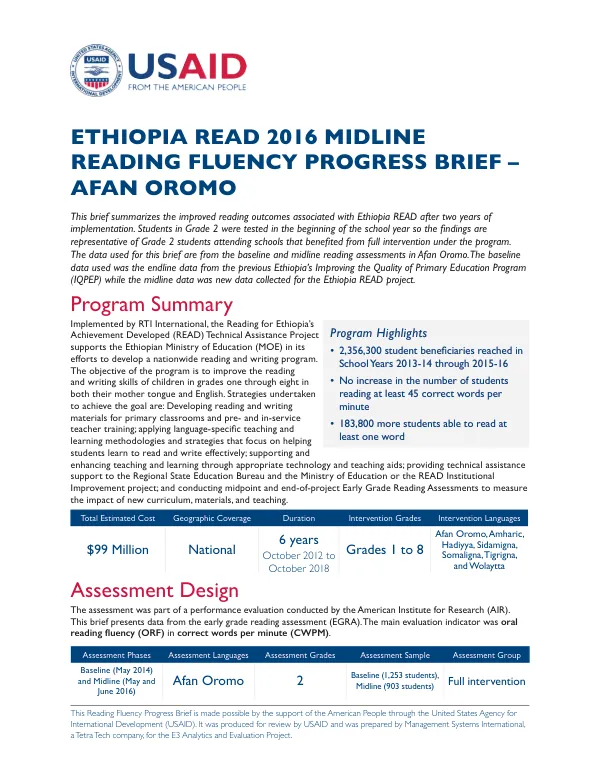
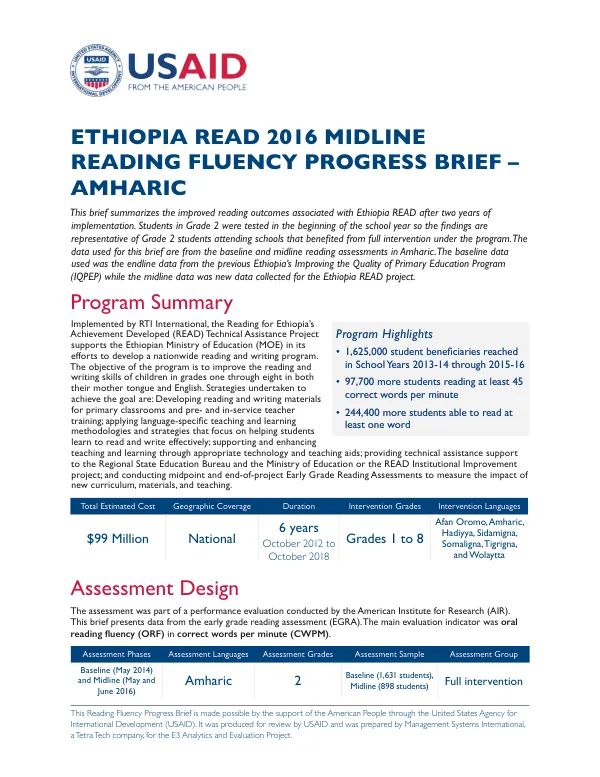
Ethiopia READ 2016 Midline Reading Fluency Progress Brief – Amharic
The Reading for Ethiopia's Achievement Developed (READ) Technical Assistance Project was implemented by RTI International to support the Ethiopian Ministry of Education in developing a nationwide reading and writing program.
2016 · 4 pages
Sign in to readA free account is required to download.
Abstract
The program aimed to improve the reading and writing skills of children in grades one through eight in both their mother tongue and English. Strategies undertaken to achieve the goal included developing reading and writing materials for primary classrooms and pre- and in-service teacher training, applying language-specific teaching and learning methodologies, and providing technical assistance support to the Regional State Education Bureau and the Ministry of Education. The program reached 1,625,000 student beneficiaries in School Years 2013-14 through 2015-16, with 97,700 more students reading at least 45 correct words per minute and 244,400 more students able to read at least one word. The total estimated cost of the program was $99 million, and it was implemented nationally over a period of six years from October 2012 to October 2018. The intervention targeted grades 1 to 8 and used seven languages, including Afan Oromo, Amharic, Hadiyya, Sidamigna, Somaligna, Tigrigna, and Wolaytta. The assessment design for the program included a performance evaluation conducted by the American Institute for Research (AIR), which used the early grade reading assessment (EGRA) tool to measure oral reading fluency (ORF) in correct words per minute (CWPM). The assessment was conducted at baseline in May 2014 and midline in May and June 2016, with a sample of 1,631 students at baseline and 898 students at midline. The assessments were conducted in Amharic and targeted full intervention schools. The results of the assessment showed that the average ORF increased overall, for males and females by 7, 7, and 5 CWPM, respectively. The reading distribution was categorized into eight bins, including non-readers, readers with a range of 1 to 60 CWPM, and fluent readers. The percentage of students by oral reading fluency in CWPM showed a significant increase in the number of students reading at least 45 CWPM, with 97,700 more students achieving this level of reading fluency. The reading statistics also showed that the average ORF increased overall, with the greatest increase observed in the 45 or more CWPM category. The assessment tool included ORF and reading comprehension components, and the assessments were conducted at similar time points near the end of each school year. Since the baseline and midline versions were statistically equated, score differences would not be due to any changes in test difficulty. Sampling weights were used to produce estimates for the population of beneficiaries, and baseline data for five languages were based on endline data from the previous IQPEP program, while Ethiopia READ collected baseline data for two languages and midline data for all seven languages.