CENTER FOR EDUCATIONAL DEVELOPMENT
Etude finale sur l’équité de genre du projet USAID Mali SIRA
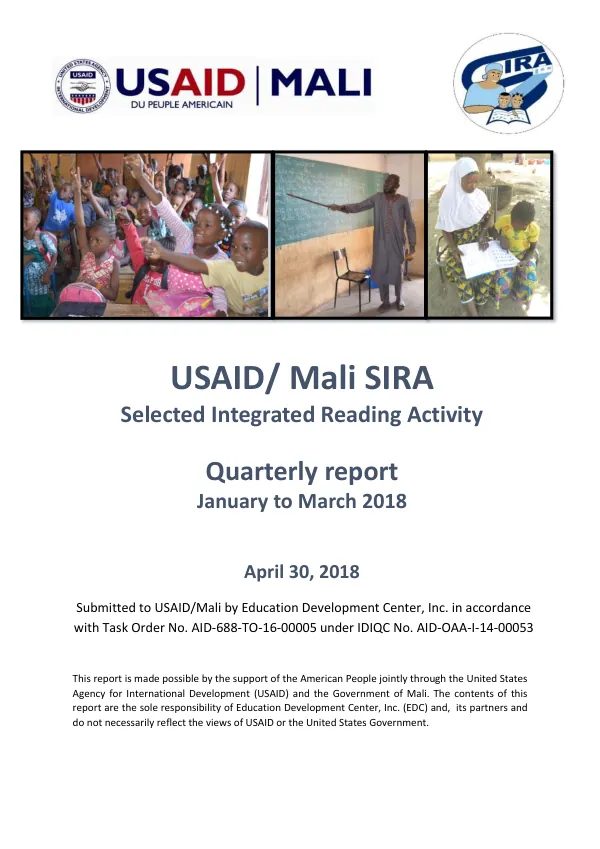
In Mali, the Selected Integrated Reading Activity (SIRA) project was launched in February 2016, initially for five years but extended to 6.5 years.
2022 · 32 pages
Sign in to readA free account is required to download.
Abstract
The project aimed to improve reading and writing skills in Bamanankan among first and second-grade students in public and community schools in the regions of Koulikoro, Ségou, and Sikasso, and in the district of Bamako. The project was implemented by Education Development Center (EDC) and its partners, including School to School International (STS), Save the Children, Œuvre Malienne d'Aide à l'Enfance au Sahel (OMAES), Cowater Sogema, and the Institut pour l'Éducation Populaire (IEP). The project was funded by USAID and overseen by the Ministère de l'Éducation Nationale (MEN), with three components: pedagogy, institutional, and participatory. In the context of the SIRA project, the final study on gender equity was conducted to assess the project's impact on gender equity in terms of inputs and outcomes. The study aimed to identify the extent to which the project had addressed gender disparities in education and to provide recommendations for future interventions. The study used data from the project's baseline, midline, and endline surveys, as well as data from the project's monitoring and evaluation system. The study analyzed data on access to education, absenteeism, quality of education, and outcomes for students and teachers. The study also examined the project's impact on gender equity in terms of teacher training, infrastructure development, and market linkage facilitation. The study found that the SIRA project had made significant progress in improving access to education for girls, particularly in rural areas. The project had also improved the quality of education, with significant gains in reading and writing skills among students. However, the study also identified areas where the project had not made sufficient progress, including in terms of teacher training and infrastructure development. The study recommended that the project continue to focus on improving access to education for girls, particularly in rural areas. The study also recommended that the project prioritize teacher training and infrastructure development to improve the quality of education. Additionally, the study recommended that the project continue to monitor and evaluate its impact on gender equity to ensure that it is meeting its goals. The SIRA project's impact on gender equity was also assessed through the analysis of data on teacher training, infrastructure development, and market linkage facilitation. The study found that the project had made significant progress in improving access to teacher training for female teachers, particularly in rural areas. The project had also improved the quality of infrastructure, with significant gains in the availability of textbooks and other educational materials. However, the study also identified areas where the project had not made sufficient progress, including in terms of market linkage facilitation. The study recommended that the project continue to focus on improving market linkage facilitation to improve the economic opportunities for female teachers and students. Overall, the SIRA project had made significant progress in improving access to education for girls, particularly in rural areas. The project had also improved the quality of education, with significant gains in reading and writing skills among students. However, the project still faced challenges in terms of teacher training and infrastructure development, and it was recommended that the project continue to prioritize these areas to ensure that it is meeting its goals.