USAID DEC
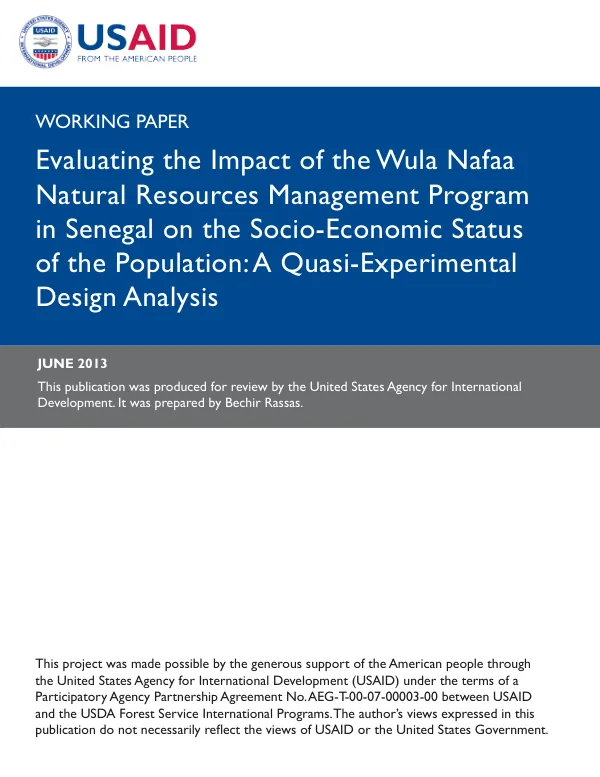
Evaluating the Impact of the Wula Nafaa Natural Resources Management Program in Senegal on the Socio-Economic Status of the Population: A Quasi-Experimental Design Analysis
Sign inINTERNATIONAL RESOURCES GROUP
Evaluating the Impact of the Wula Nafaa Natural Resources Management Program in Senegal on the Socio-Economic Status of the Population: A Quasi-Experimental Design Analysis
The Wula Nafaa Natural Resources Management Program in Senegal was initiated in 2003 with the objective of contributing to poverty reduction and sustainable local development.
2013 · 64 pages
Sign in to readA free account is required to download.
Abstract
The program aimed to increase the income of rural producers and local communities through the empowerment of local authorities and the promotion of integrated, decentralized, participatory resource management. This approach was based on the understanding that natural resource management rests on three interrelated development dimensions: environmental management, economic considerations, and governance systems. The program's overall strategy involved the implementation of a quasi-experimental design analysis to evaluate its impact on the socio-economic status of the population. The analysis was conducted using data from the Demographic and Health Survey (DHS) and other relevant sources. The study focused on the Wula Nafaa areas and control areas, with the goal of determining the effectiveness of the program in improving the socio-economic status of the population. The analysis revealed significant improvements in the socio-economic status of households in the Wula Nafaa areas compared to the control areas. The study found that households in the Wula Nafaa areas had higher levels of ownership of durable assets, such as electricity and piped water, and better access to employment, education, and nutrition. The analysis also showed that the program had a positive impact on the wealth status of households, with a significant increase in the percentage of households having access to electricity and piped water. The study's findings suggest that the Wula Nafaa program has been successful in achieving its objectives, particularly in terms of improving the socio-economic status of households in the program areas. The program's approach to natural resource management, which emphasizes the importance of environmental management, economic considerations, and governance systems, appears to have been effective in promoting sustainable local development and poverty reduction. The analysis also highlights the importance of considering the three dimensions of natural resource management (environmental management, economic considerations, and governance systems) in program design and implementation. The study's findings suggest that a more integrated and participatory approach to natural resource management can lead to better outcomes and more sustainable development. The Wula Nafaa program's focus on empowering local authorities and promoting decentralized, participatory resource management has been instrumental in achieving these outcomes. The study's results have implications for the design and implementation of natural resource management programs in Senegal and other countries. The findings suggest that programs that prioritize environmental management, economic considerations, and governance systems are more likely to achieve sustainable development and poverty reduction outcomes. The study's methodology and results can inform the development of more effective and sustainable natural resource management programs in the future.