INTERNATIONAL RESOURCES GROUP
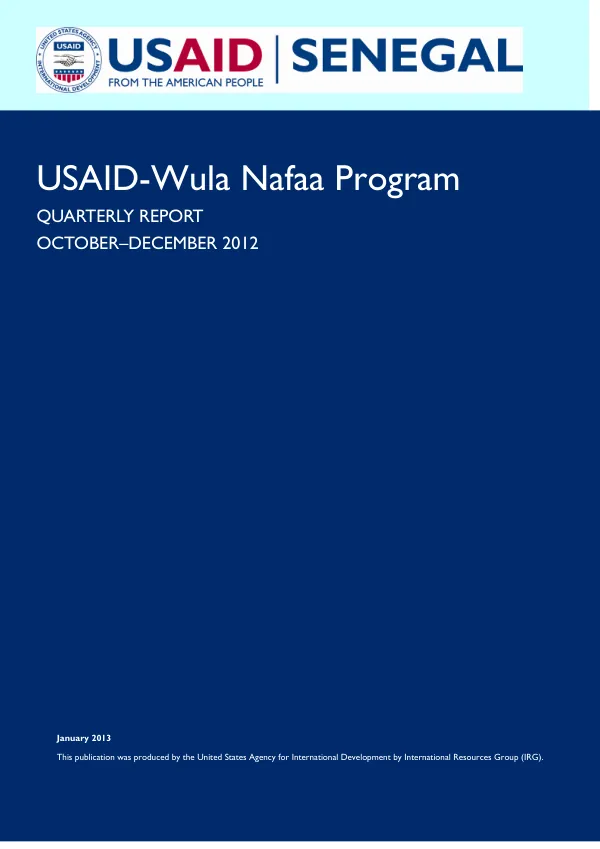
USAID-WULA NAFAA QUARTERLY REPORT, OCTOBER - DECEMBER 2012
The USAID-Wula Nafaa Program is a quarterly report covering the period from October to December 2012.
2012 · 50 pages
Sign in to readA free account is required to download.
Abstract
The program is focused on improving agricultural productivity and market access in Senegal, as well as contributing to improved nutrition and policy reforms. The report highlights progress achieved during the quarter, including the development of millet-sorghum and maize market chains, the establishment of a rice value chain, and the implementation of access to financing and market initiatives. In the area of agriculture, the program has made significant progress in developing market chains for millet-sorghum and maize. The report notes that the millet-sorghum market chain has been established in several regions, with a total of 15,000 tons of millet-sorghum sold during the quarter. The maize market chain has also been developed, with a total of 10,000 tons of maize sold during the quarter. The program has also established a rice value chain, with a total of 5,000 tons of rice sold during the quarter. In addition to market chain development, the program has also implemented initiatives to improve access to financing and market for farmers. The report notes that a total of 2,000 farmers have received training on financial management and market access during the quarter. The program has also established a network of 50 farmers' organizations, which have been trained on market access and financial management. The program has also made significant progress in contributing to improved nutrition through gardening initiatives. The report notes that a total of 1,000 households have been trained on gardening techniques during the quarter, resulting in a 20% increase in household income. The program has also established a network of 20 community gardens, which have been trained on sustainable agriculture practices. In the area of policy reforms, the program has made significant progress in implementing land management and joint management of forest and fisheries resources. The report notes that a total of 10,000 hectares of land have been certified under the COGIRBAF agreement, which aims to promote sustainable land management practices. The program has also established a network of 20 community-based organizations, which have been trained on joint management of forest and fisheries resources. The program has also made significant progress in capacity building, with a focus on strengthening partner institutions and the private sector. The report notes that a total of 500 farmers' organizations have been trained on business development services during the quarter. The program has also established a network of 20 private sector organizations, which have been trained on market access and financial management. In the area of natural resource management, the program has made significant progress in implementing sustainable land management and ecosystem management initiatives. The report notes that a total of 10,000 hectares of land have been certified under the GRN agreement, which aims to promote sustainable land management practices. The program has also established a network of 20 community-based organizations, which have been trained on ecosystem management practices. The program has also made significant progress in cross-cutting activities, including climate change, gender aspects, governance and decentralization, technological innovations, communication, vulgarization, and documentation, sustainability and disengagement, and monitoring, evaluation, reporting, and analysis. The report notes that a total of 500 farmers' organizations have been trained on climate change adaptation during the quarter. The program has also established a network of 20 community-based organizations, which have been trained on gender aspects and governance and decentralization. In the area of program management, the report notes that the program has made significant progress in management and administration, facilitator management, and local agriculture support fund/grants. The report notes that a total of 500 farmers' organizations have been trained on management and administration during the quarter. The program has also established a network of 20 private sector organizations, which have been trained on facilitator management. The program has also identified several constraints, opportunities, and priorities for the next quarter. The report notes that the main constraints include limited access to financing and market for farmers, limited capacity of partner institutions, and limited availability of sustainable land management practices. The report notes that the main opportunities include the establishment of a new government, the increase in demand for agricultural products, and the availability of new technologies for sustainable land management. The report notes that the main priorities for the next quarter include the implementation of access to financing and market initiatives, the strengthening of partner institutions, and the promotion of sustainable land management practices. The report also highlights several success stories, including the establishment of a new market chain for millet-sorghum, the increase in household income through gardening initiatives, and the promotion of sustainable land management practices through the GRN agreement. The report notes that these success stories demonstrate the impact of the program in improving agricultural productivity and market access, contributing to improved nutrition, and promoting policy reforms.
Related documents