USAID DEC
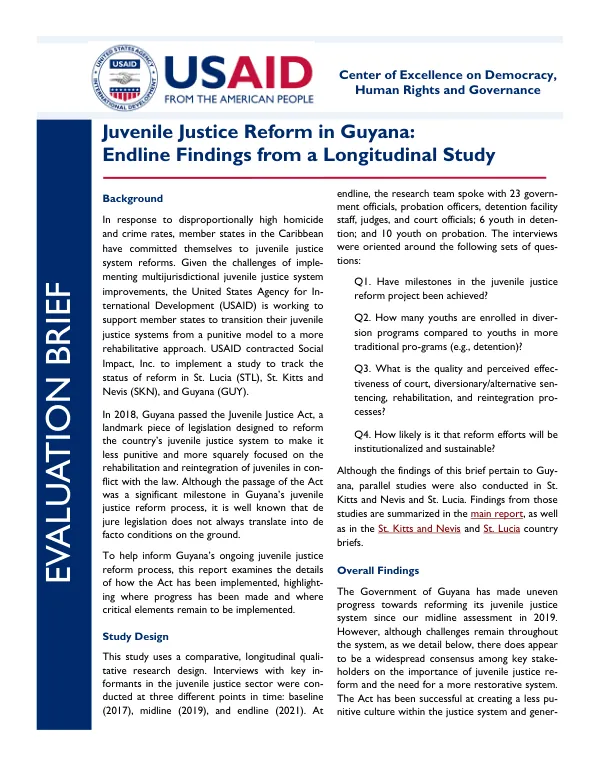
Evaluation Brief: Baseline Study Findings of Juvenile Justice Reform Implementation in Guyana
Sign inSOCIAL IMPACT, INC.
Evaluation Brief: Baseline Study Findings of Juvenile Justice Reform Implementation in Guyana
The juvenile justice reform implementation in Guyana is part of a larger impact evaluation aimed at understanding the effectiveness of juvenile justice sector reforms in reducing recidivism and improving reintegration of justice-involved juveniles.
2018 · 2 pages
Sign in to readA free account is required to download.
Abstract
The reform implementation study focuses on the implementation of reforms and builds on existing research to track the status and quality of reform efforts. The study uses a comparative, longitudinal, qualitative approach, collecting baseline data in March-April 2017, midline data in early 2019, and endline data in late 2020. The baseline study found limited advancement in juvenile justice sector reforms in Guyana, with some evidence of backsliding. The age of criminal responsibility for juveniles remains 10 years old, and youth over 16 are legally classified as adults. Informants reported that girls and the most socioeconomically vulnerable children are charged with "wandering" at disproportionate rates, with over 50 percent of female juveniles in detention detained on this charge. Pre-trial diversion and alternative sentencing programs are also limited in Guyana. The police department has a formal pre-trial diversion program, but informal diversion is also reportedly occurring through the Probation department. However, only around 100 youth are participating in supervised, youth work programs, and there is no accurate count of youth in formal and informal diversion and alternative sentencing programs. Several magistrates reported frustration with the lack of alternative sentencing options, particularly for "wandering" charges. Detention facilities in Guyana also pose significant challenges. At the time of data collection, there were 81 juveniles detained in the New Opportunities Corps, 35 in the Sophia Detention Center, and 16 in the adult Timehri Prison. New Opportunities Corps provides limited vocational training, while Sophia Holding Centre offers occasional sports and classes, but limited formalized education. Timehri Prison has been reported to use the legally sanctioned practice of a punishment diet, whereby food intake is restricted for extended periods. Reintegration efforts in Guyana are also limited. While an aftercare program and community care point are reportedly available to help with reintegration, a process mapping exercise revealed limited follow-up once a juvenile is released from the New Opportunities Corps. There are also logistical and financial challenges for probation officers and social workers to reach out to juveniles. Overall, the baseline study findings suggest that significant challenges remain in the juvenile justice sector in Guyana, and that reform efforts are needed to address these issues.
Related documents