USAID DEC
Improving Quality of Care in Guyana: A Case Study of Clinical Mentoring and Supportive Supervision
Sign inUSAID
Improving Quality of Care in Guyana: A Case Study of Clinical Mentoring and Supportive Supervision
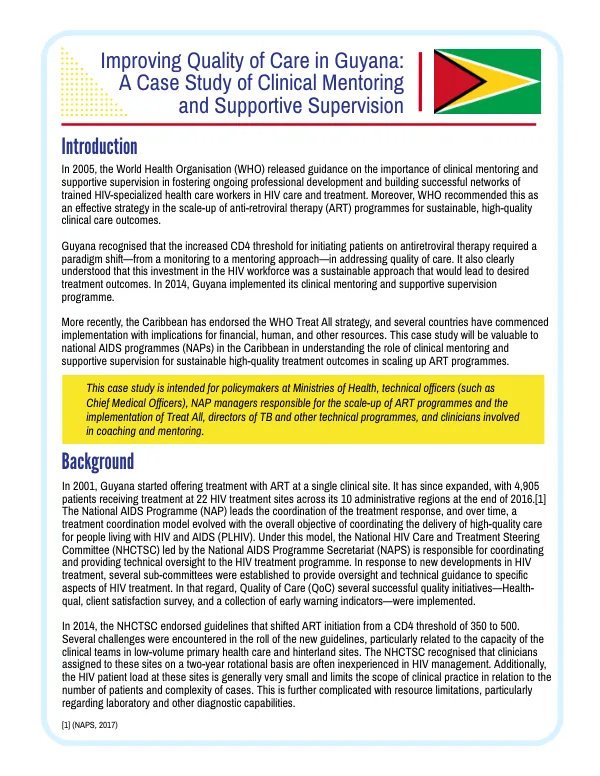
The clinical mentoring and supportive supervision programme in Guyana was established in 2014 to address the challenges of implementing the new ART initiation guidelines, which shifted from a CD4 threshold of 350 to 500.
7 pages
Sign in to readA free account is required to download.
Abstract
The programme aimed to enhance the quality of care and build the capacity of HIV practitioners in low-volume primary health care and hinterland sites. The programme utilized a multipronged approach, including face-to-face clinical mentoring and supportive supervision. Experienced HIV clinicians, known as mentors, were trained to provide ongoing capacity building of HIV practitioners and ensure the effective functioning of HIV treatment sites. The mentors possessed extensive HIV management experience and were responsible for delivering a 12-module curriculum to mentees over a two-week period. The curriculum addressed all aspects of managing an HIV patient, including the use of antiretroviral therapy, monitoring of patients on treatment, and diagnosing and treating opportunistic infections and co-morbid conditions. The mentors also conducted supportive supervision with the entire clinical team, addressing issues related to the clinic environment, supply chain management, and staff issues. Mentoring continued beyond the initial two-week intensive, with semiannual visits to assigned sites and mentees to provide clinical guidance and supportive supervision. During these visits, mentors reviewed patient charts to determine compliance with national HIV treatment guidelines and defined standards of care. Chart reviews were conducted jointly with the mentee and focused on key parameters of quality of care, such as ART initiation, laboratory monitoring, patient follow-up, and management of co-infections and comorbidities. The programme had a positive impact on the quality of care and the capacity of HIV practitioners in Guyana. Mentees reported that the programme provided them with a comprehensive experience in managing HIV patients and helped them to develop an extra love for clinical management and HIV management. The programme also helped to improve the management of patients, with mentors providing valuable advice and guidance to mentees. The clinical mentoring and supportive supervision programme in Guyana is an example of a successful initiative that has improved the quality of care and built the capacity of HIV practitioners in a resource-constrained setting. The programme's multipronged approach, including face-to-face clinical mentoring and supportive supervision, has been effective in addressing the challenges of implementing the new ART initiation guidelines and enhancing the quality of care. The programme's success has been attributed to the experienced mentors who possess extensive HIV management experience and are responsible for delivering the 12-module curriculum to mentees. The programme's focus on building the capacity of HIV practitioners and ensuring the effective functioning of HIV treatment sites has also been critical to its success. The clinical mentoring and supportive supervision programme in Guyana has been recognized as a valuable initiative for national AIDS programmes in the Caribbean, particularly in understanding the role of clinical mentoring and supportive supervision for sustainable high-quality treatment outcomes in scaling up ART programmes. The programme's success has also been recognized by the World Health Organization, which has endorsed the programme as a model for other countries to follow. The programme's impact on the quality of care and the capacity of HIV practitioners in Guyana has been significant, with mentees reporting improved management of patients and increased confidence in their ability to provide high-quality care. The programme's success has also been attributed to the collaborative approach, with mentors working closely with mentees and the clinical team to address issues related to the clinic environment, supply chain management, and staff issues.