USAID
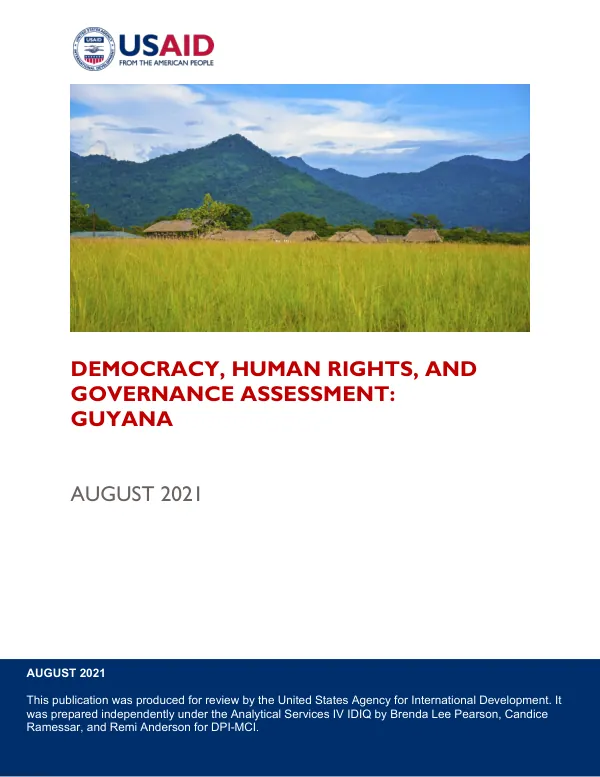
Democracy, Human Rights, and Governance Assessment: Guyana
The democracy, human rights, and governance (DRG) assessment for Guyana was conducted to provide the Eastern and Southern Caribbean (ESC) Mission with analysis and recommendations.
2021 · 68 pages
Sign in to readA free account is required to download.
Abstract
The assessment is based on USAID's DRG Strategic Assessment Framework and identifies key DRG opportunities and challenges in Guyana. The report provides a political economy analysis of reform supporters and opponents within the DRG sector, and offers strategic recommendations that account for Mission priorities, available resources, and the initiatives of other donors and stakeholders. Guyana's political economy and socio-cultural context provide the settings for this DRG assessment. The country's origins, history, cultural foundations, and other contextual factors provide nuanced information that assists the Assessment Team to analyze the DRG elements and identify the associated DRG challenges, as well as the structural constraints, opportunities, and interests of key actors who can promote or hinder political reform in a country. The main conclusion of this exercise was that the broader context of consensus and inclusion are the underlying challenges for Guyanese citizens and impede the framing of a common vision of the country's future. The ruling party, the People's Progressive Party (PPP) and the opposition coalition the A Partnership for National Unity and Alliance for Change (APNU+AFC) need to find a way to form a functioning democracy based on power-sharing rather than a "winner takes all" mentality. This would ensure that the unprecedented wealth in oil reserves can be transparently and equitably managed for the benefit of all Guyanese. The assessment team conducted a robust desk review of articles and documents that reflect the most significant political and economic changes, donor priorities, and external drivers of change that have impacted Guyana in the period 2016-2021. The assessment found problems in all five elements of democracy, human rights, and governance. The most critical are in the areas of competition and political accountability, consensus and inclusion. Competition and political accountability are hindered by the fact that political parties have been organized along ethnic lines since before independence. Indo-Guyanese have supported the People's Progressive Party Civic (PPP/C) party since 1950 while Afro-Guyanese have supported the People's National Congress (PNC), the largest political party of the APNU+AFC coalition, since 1957. The discovery of substantial offshore oil and natural gas deposits will transform the country's economy and ability to achieve national development objectives. However, the disputed outcome of the March 2020 national elections led to a five-month stalemate and a refusal by the opposition to recognize the legitimacy of the new government. Two local elections held in 2016 and 2018 were won by PPP/C and were characterized by low voter turnout; the political polarization of governing issues by the two major political parties overshadowed attempts at decentralization of government services and empowering local officials. Crime and security issues are negatively impacted by external drivers: migrants from Venezuela, international drug and weapons trafficking, and internal drivers: economic impact of Covid-19, political polarization, and lack of national consensus and inclusivity. Political power is highly centralized in the executive branch of government that reinforces a one-party rule dominated closely with a single ethnic group. Institutions not affiliated with the executive branch are weak and do not have a strong tradition of ensuring government accountability. The country's proportional system for representation in the National Assembly often makes lawmakers more accountable to party leaders rather than to constituents in their regions. Government accountability hinges a great deal on how it handles electoral reform and whether meaningful steps are taken to empower local officials. National consensus on critical development and economic issues seems elusive due to the prolonged political instability that has widened the political and racial divide within Guyana. Although both political parties have a shared commitment to a democratic system, there is little agreement on how to achieve consensus for necessary electoral and institutional reforms and stewardship of national wealth. It is incumbent on the government, parliament, and the citizens to reach across the racial and ethnic divide to come to a common vision of a new national development plan. The lack of political agreement regarding policy priorities for economic opportunities and social benefits perpetuates long-standing disparities in the country. The assessment team recommends that the government, parliament, and citizens work together to achieve consensus on critical development and economic issues. This can be achieved by establishing a national development plan that prioritizes economic opportunities and social benefits for all Guyanese. The government should also take meaningful steps to empower local officials and decentralize government services to reduce the concentration of power in the executive branch. Furthermore, the government should prioritize electoral reform to ensure that the electoral system is fair and representative of the people's will. This can be achieved by introducing proportional representation and ensuring that the electoral commission is independent and impartial. The government should also take steps to address the root causes of crime and security issues, including the economic impact of Covid-19, political polarization, and lack of national consensus and inclusivity. In conclusion, the DRG assessment for Guyana highlights the need for the government, parliament, and citizens to work together to achieve consensus on critical development and economic issues. This can be achieved by establishing