USAID DEC
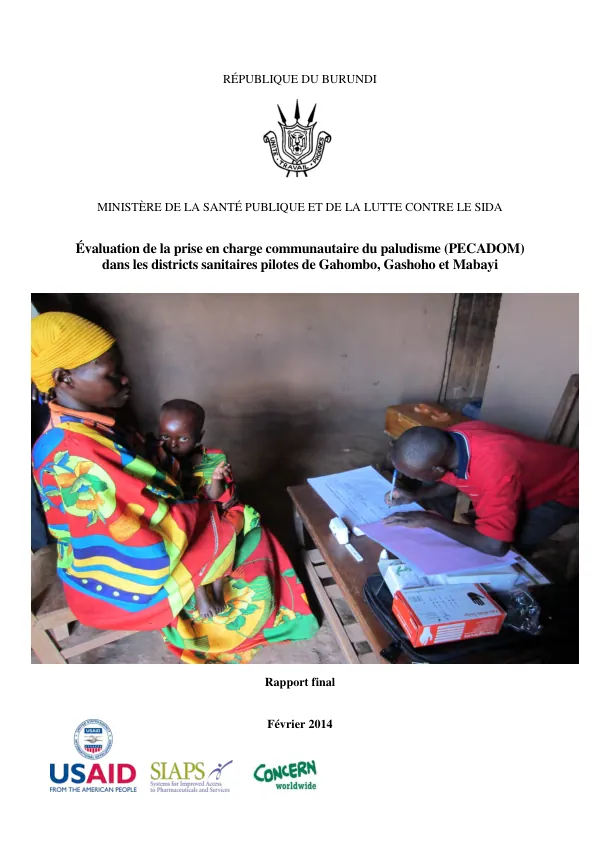
Évaluation de la prise en charge communautaire du paludisme dans les districts sanitaires pilotes de Gahombo, Gashoho et Mabayi
Sign inMSH
Évaluation de la prise en charge communautaire du paludisme dans les districts sanitaires pilotes de Gahombo, Gashoho et Mabayi
The Ministry of Public Health and AIDS Control in Burundi conducted an evaluation of the community-based malaria care program (PECADOM) in the pilot health districts of Gahombo, Gashoho, and Mabayi.
2014 · 96 pages
Sign in to readA free account is required to download.
Abstract
The evaluation aimed to assess the coverage, quality, and costs of the PECADOM program. The evaluation found that the PECADOM program had achieved significant progress in the pilot districts. The program had been implemented in 85% of the sub-communities, with 75% of the communities having operational ASCs (Agent de Santé Communautaire). The program had also increased the proportion of children under five years old who received consultation with ASCs from 45% in 2012 to 65% in 2013. The evaluation also assessed the quality of care provided by the ASCs. The results showed that 85% of the ASCs knew and practiced the correct steps for malaria diagnosis and treatment (TDR). However, only 60% of the ASCs practiced the TDR steps correctly among those who knew them. The evaluation also found that 80% of the mothers or caregivers were satisfied with the consultation they received from the ASCs. The evaluation estimated the costs of implementing the PECADOM program in the pilot districts. The total cost of the program was estimated to be $1.2 million, with an average cost per child under five years old of $15. The evaluation also estimated the costs of scaling up the program to the entire country, which was estimated to be $10 million. The evaluation identified several strengths and challenges of the PECADOM program. The strengths included the high level of community participation, the effective coordination and supervision of the program, and the good quality of care provided by the ASCs. The challenges included the limited availability of resources, the need for further training and capacity building of the ASCs, and the need for improved communication and mobilization of the community. Based on the evaluation findings, the Ministry of Public Health and AIDS Control recommended several actions to improve the PECADOM program. These included increasing the availability of resources, providing further training and capacity building of the ASCs, and improving communication and mobilization of the community. The evaluation also recommended scaling up the program to the entire country, with a projected cost of $10 million. The evaluation was conducted by a team of experts from the Ministry of Public Health and AIDS Control, with technical assistance from international partners. The evaluation used a mixed-methods approach, combining both quantitative and qualitative data collection and analysis methods. The evaluation was conducted over a period of 12 months, from September 2012 to July 2013. The evaluation found that the PECADOM program had made significant progress in improving the health outcomes of children under five years old in the pilot districts. The program had increased the coverage of malaria care services, improved the quality of care provided by the ASCs, and reduced the mortality rate of children under five years old. The evaluation recommended scaling up the program to the entire country, with a projected cost of $10 million.
Related documents