UNIVERSITAS DUKE
SEAD FY21 Annual Report (Final Program Report)
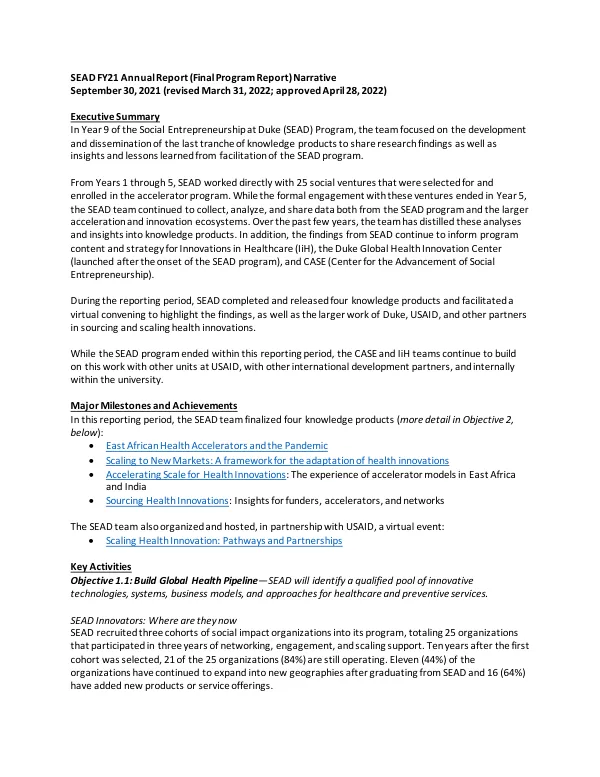
The SEAD program, a social entrepreneurship initiative, focused on developing and disseminating knowledge products to research findings and insights from the facilitation of the program.
2021 · 6 pages
Sign in to readA free account is required to download.
Abstract
The team worked directly with 25 social ventures from Years 1 through 5, but continued to engage with these ventures through the Innovations in Healthcare (IiH) team. The SEAD team completed and released four knowledge products, including "East African Health Accelerators and the Pandemic," "Scaling to New Markets: A framework for the adaptation of health innovations," "Accelerating Scale for Health Innovations: The experience of accelerator models in East Africa and India," and "Sourcing Health Innovations: Insights for funders, accelerators, and innovators." The program's objective was to identify a pool of innovative technologies, systems, business models, and approaches for healthcare and preventive services. The SEAD team also organized and hosted a virtual convening, "Health Innovation: Pathways and Partnerships," in collaboration with USAID. The SEAD team continued to engage with global health social entrepreneurs through virtual convenings, panel discussions, and key informant interviews. The team highlighted SEAD innovators in knowledge products, including articles in the Stanford Social Innovation Review and case studies in the Scaling to New Markets paper. The SEAD program served as a bridge between health social entrepreneurs and the impact investment community, facilitating increased access to investors, innovative deal structures, instruments, and funding instruments. The CASE team continued to engage new impact investors through CASE Smart Impact Capital. The SEAD team broadened understanding of the conditions that foster or inhibit effective, scalable innovations in health and preventive services. The team recommended regulatory and sector mechanisms to foster more innovation and effective scaling of impact. The SEAD program's efforts focused on finalizing and disseminating knowledge products that capture and extend learnings from the program. The SEAD team's work plan included three objectives: Build Global Health Pipeline, Develop Resources and Capabilities, and Leverage Impact Investing. The team's efforts were informed by the journeys, needs, and insights of SEAD innovators, including LifeNet International and Noora Health. LifeNet International expanded its operations into four additional countries, including the Democratic Republic of the Congo, Malawi, Kenya, and Ghana. Noora Health trained family members in key aspects of post-acute care, reducing readmissions by 71% for cardiac care patients and 56% for newborn patients. The SEAD program's work plan also included enhancing knowledge and policy objectives, which focused on broadening understanding of the conditions that foster or inhibit effective, scalable innovations in health and preventive services. The team's efforts were informed by the journeys, needs, and insights of SEAD innovators, including LifeNet International and Noora Health. The SEAD team's work plan included several key informant interviews with SEAD innovators, including Abhinav Girdhar, Bodhi Health, and Eva Mwai, North Star Alliance. The team's efforts were also informed by the journeys, needs, and insights of SEAD innovators, including LifeNet International and Noora Health. The SEAD program's work plan included several key objectives, including building a global health pipeline, developing resources and capabilities, and leveraging impact investing. The team's efforts were informed by the journeys, needs, and insights of SEAD innovators, including LifeNet International and Noora Health. The SEAD program's work plan included several key objectives, including building