MEASURE EVALUATION PRH
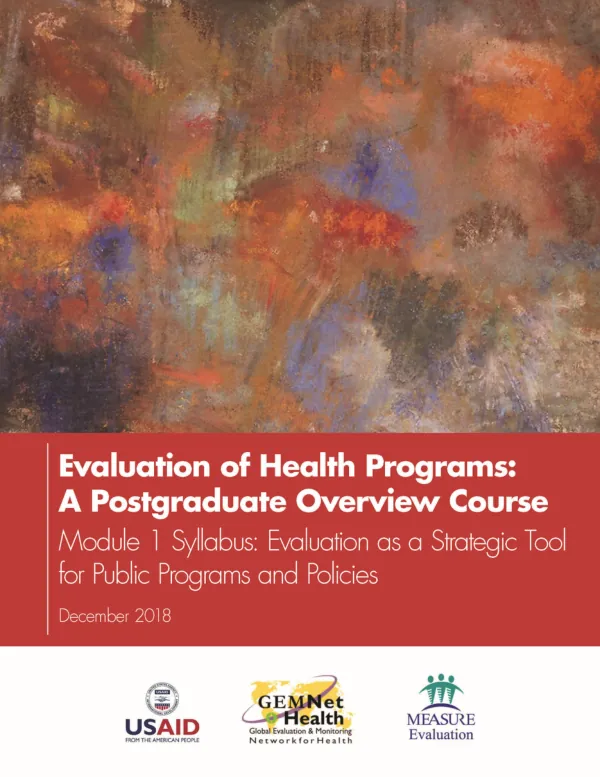
Evaluation of Health Programs: A Postgraduate Overview Course
The Global Evaluation and Monitoring Network for Health (GEMNet-Health) and MEASURE Evaluation have developed a competency-based curriculum for a master's degree level overview course on evaluation of health programs.
2018 · 12 pages
Sign in to readA free account is required to download.
Abstract
The course is designed to strengthen postgraduate education on evaluation of health programs. The curriculum materials are modular, with each module functioning as a standalone unit that can be incorporated into other courses, workshops, or trainings. The modules are designed to cover core competencies for evaluation of health programs. Module 1 focuses on evaluation as a strategic tool for public programs and policies. The module covers competencies such as discussing evaluation in the context of public policy, analyzing the policy cycle and results chain, and assessing the role of evaluation for policymaking. The module is divided into two sessions. Session 1, Monitoring and Evaluation within the Public Policy Cycle, covers topics such as the overview of monitoring and evaluation, policies, public policies, and policy agendas. The session includes activities such as group exercises and plenary discussions. The facilitator uses PowerPoint presentations, lecture notes, and case studies to deliver the content. Session 2, Evaluation to Inform Evidence-Based Policies and Programs, focuses on illustrating the use of evaluation to inform evidence-based policies and programs. The session covers topics such as what are evidence-based policies, how evaluation informs and influences policy, and how politics affect evaluation work. The session includes activities such as group discussion and case study. The module includes a list of recommended readings, which include articles and books on evaluation and health policy. The module also includes a case study on early childhood development, which illustrates the use of evaluation to inform evidence-based policies and programs. The module is designed to be delivered in 4 hours, with 2 hours for each session. The facilitator uses a variety of teaching methods, including lecture, group discussion, and case study. The module includes materials such as PowerPoint presentations, flip chart paper, markers, and projection equipment. The Global Evaluation and Monitoring Network for Health (GEMNet-Health) is a global network of public health institutions that aims to foster organizational growth, collaboration, and mutual support for monitoring and evaluation of health programs globally. The network provides a platform for members to share knowledge, expertise, and resources to improve the quality of health programs. The competency-based curriculum developed by GEMNet-Health and MEASURE Evaluation is designed to provide students with the knowledge and skills needed to evaluate health programs effectively. The curriculum covers core competencies for evaluation of health programs, including discussing evaluation in the context of public policy, analyzing the policy cycle and results chain, and assessing the role of evaluation for policymaking. The curriculum is modular, with each module functioning as a standalone unit that can be incorporated into other courses, workshops, or trainings. The modules are designed to be delivered in a flexible format, allowing students to complete them at their own pace. The curriculum includes a range of teaching methods, including lecture, group discussion, and case study, to engage students and promote learning. The competency-based curriculum developed by GEMNet-Health and MEASURE Evaluation is an important resource for students and professionals in the field of health evaluation. It provides a comprehensive framework for evaluating health programs and policies, and it is designed to be flexible and adaptable to different contexts and settings. The curriculum includes a range of topics and activities, including group exercises, plenary discussions, and case studies. The facilitator uses a variety of teaching methods, including lecture, group discussion, and case study, to deliver the content. The module includes materials such as PowerPoint presentations, flip chart paper, markers, and projection equipment. The
Related documents