USAID DEC
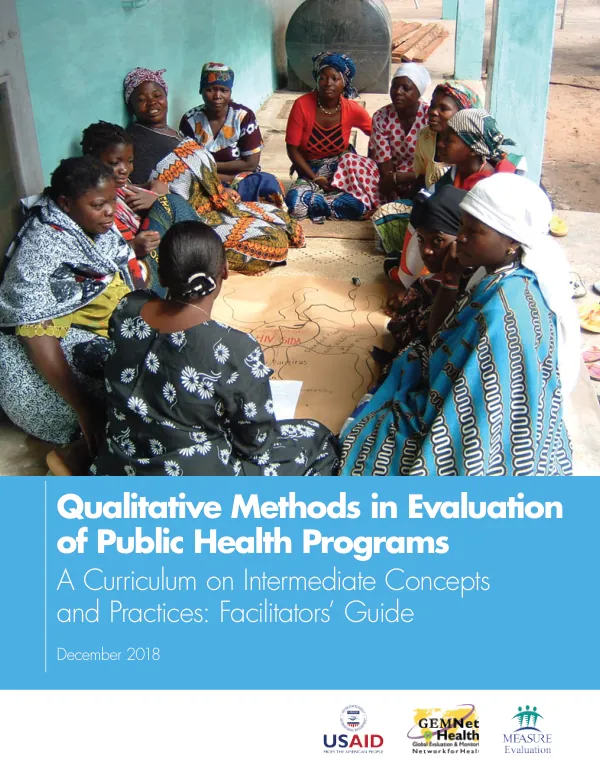
Qualitative Methods in Evaluation of Public Health Programs: A Curriculum on Intermediate Concepts and Practices: Facilitators’ Guide
Sign inICF
Qualitative Methods in Evaluation of Public Health Programs: A Curriculum on Intermediate Concepts and Practices: Facilitators’ Guide
Qualitative evaluation plays a crucial role in rigorous evaluation of public health programs, providing valuable insight into complex issues that quantitative methods may not address.
2018 · 100 pages
Sign in to readA free account is required to download.
Abstract
This approach allows for the exploration of the "why" behind program successes or challenges, illuminating the uniquely human side of health programming and highlighting important contextual factors such as culture, gender, or societal norms. Qualitative evaluation can be used to complement quantitative data, answer questions not accessible quantitatively, or provide a cost-effective data source when one would not otherwise be available. The course "Qualitative Methods in Evaluation of Public Health Programs" is designed to assist health professionals in using qualitative evaluation skills in sound and rigorous evaluation of their programs. The sessions go beyond basic concepts to explore important considerations of qualitative methods in the context of rigorous evaluation. Through session content and participatory exercises, participants will gain basic skills in rigorous qualitative data collection, analysis, and use. The course was developed by a global group of experts in 2015-2017 and pilot-tested in Mexico and Ghana in 2017. It was revised in 2018 based on feedback from participants. The course responds to an important need to build the qualitative methods capacity of health professionals involved in implementing and/or managing evaluations of public health programs in lower- and middle-income countries. Despite widespread interest in the effectiveness of health programs and common use of qualitative data in program evaluation, the quality of qualitative evaluation methods is often overlooked in practice and in existing qualitative methods short courses. The course covers a range of topics, including the introduction to paradigms and qualitative evaluation, creating and conceptualizing qualitative evaluation questions, troubleshooting in selected qualitative methods for evaluation, and developing data collection tools. It also covers sampling strategies and saturation, qualitative data analysis techniques for drawing themes, and quality research standards for qualitative inquiry. Additionally, the course covers data presentation and dissemination, key ethical principles in qualitative evaluation, and integrating gender into evaluation. The course is designed to be practical and participatory, with a focus on hands-on exercises and group work. Participants will have the opportunity to engage with the material through a range of activities, including case studies, group discussions, and hands-on exercises. The course is intended for health professionals involved in implementing and/or managing evaluations of public health programs in lower- and middle-income countries. The course is structured around 12 sessions, each of which covers a specific topic related to qualitative evaluation. The sessions are designed to be self-contained, allowing participants to dip in and out of the material as needed. The course also includes a range of appendices, which provide additional resources and support for participants. Overall, the course "Qualitative Methods in Evaluation of Public Health Programs" is a valuable resource for health professionals involved in implementing and/or managing evaluations of public health programs in lower- and middle-income countries. It provides a comprehensive introduction to qualitative evaluation methods and skills, and is designed to be practical and participatory.