USAID DEC
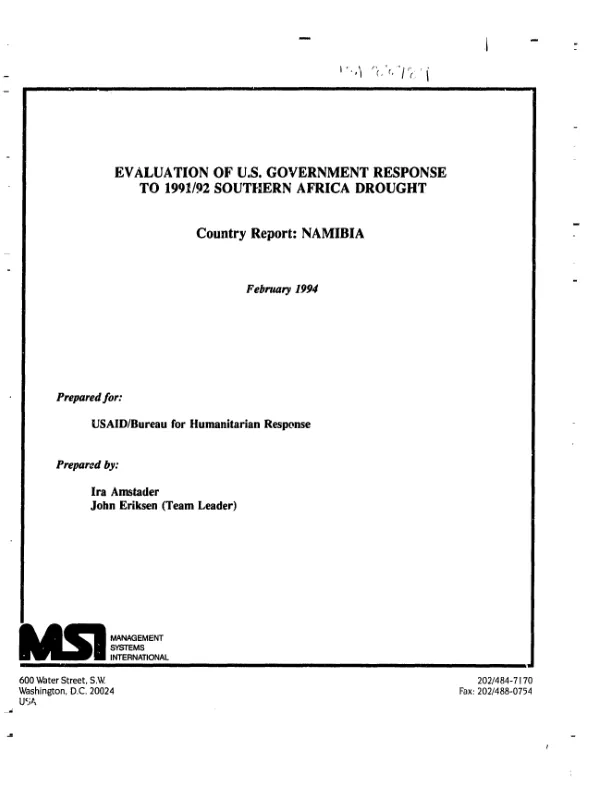
Evaluation of US Government response to 1991/92 Southern Africa drought -- country report : Namibia
Sign inMANAGEMENT SYSTEMS INTERNATIONAL, INC. (MSI)
Evaluation of US Government response to 1991/92 Southern Africa drought -- country report : Namibia
Evaluates the U.S.
Amstader, Ira; Eriksen, John · 1994
Sign in to readA free account is required to download.
Abstract
response to the 1991-92 drought in Namibia, and provides lessons learned related to food distribution, water and resource management, and institutional development. Evaluation of food distribution activities resulted in the following conclusions. (1) Financial grants may be less disruptive to the economy than the direct import of commodities; grants increase the capacity of vulnerable groups to purchase food in domestic commercial markets and to select from a wider range of commodities. (2) Distribution of different drought relief packages for different segments of the target population based on age, sex, or other criteria was unworkable and inappropriate to the social context (Namibian families share their food). Also, organizations involved in food distribution had difficulty simultaneously stocking many commodities included in the packages, and delivering even partial packages, under field conditions. (3) In the past, Food For Work (FFW) activities attempted in Namibia during drought have been largely unsuccessful. So too were these FFW activities, which in many cases were ill-conceived, hastily designed, poorly executed, unsustainable, and expensive, and in which only a very small group participated. (4) Occasionally, donors supplied commodities that were inappropriate or already available in Namibia"s commercial market, including tinned and fried fish, cooking oil and beans, and leftover Gulf War stock. Evaluation of water and resource management activities resulted in the following conclusions. (1) Water must be seen as an input into a resource management system and not an objective in itself. Development of water sources is likely to have adverse economic and environmental consequences where well-established community-based resource management systems did not already exist. (2) Water resource development should not aim to meet short-term political objectives, but be pursued only in the context of long-term, well-articulated development programs. (3) Development of local water resources for human consumption in targeted locations may be appropriate in a drought mitigation program, but not for livestock. In fact, the periodic absence of water in overgrazed areas provides an opportunity to force reductions in grazing pressures; during droughts, the principal cause of livestock mortality is lack of forage resources, not water. In this instance, U.S. support for installation of additional boreholes unfortunately reinforced the Namibian government"s emphasis on borehole development as the primary means of supplying water to both humans and livestock. The following lessons were learned regarding institutional aspects. (1) The most significant impact of the drought relief effort may be that the Namibian government is reorganizing its institutions to better meet needs of people in communal areas, and inter-ministerial coordination has improved. (2) The formal government, donor, NGO coordination mechanism did not promote frequent or frank discussion related to drought relief; for example, some donor representatives were not sufficiently critical of government presentations during meetings with the government, while others were overly aggressive in pushing individual agendas. Although donors and NGOs engaged in useful informal discussions, there were never any formal fora, independent of the government, which could have eased tensions that arose between implementors. (3) Government/donor/NGO discussions failed to arrive at a working distinction between activities appropriate to emergency relief and those appropriate for longer-term development objectives, which would be better implemented with "programmed" food aid. This deficiency was particularly true in the case of FFW activities, but also with respect to water development schemes. (4) Devolution of responsibilities to regional and local authorities must be accompanied by appropriate and timely financial transfers; regional committees were not provided with sufficient financial resources to distribute commodities in a timely manner. (5) Properly planned and implemented short-term relief efforts are likely to be self-terminating and should not engender long-term dependencies among local constituencies. Dependency can be engendered when the host government confuses short-term drought relief with longer-term development objectives, and tries to capitalize upon the temporary emergency situation to further its development objectives. (6) Drought needs assessments should pay greater attention to the fact that food commodities and livestock regularly flow back and forth over the Namibia/Angola border, in response to changes in annual rainfall patterns and economic conditions. These exchanges are facilitated by the presence of the same ethnic groups on both sides of the frontier.
Related documents