USAID DEC
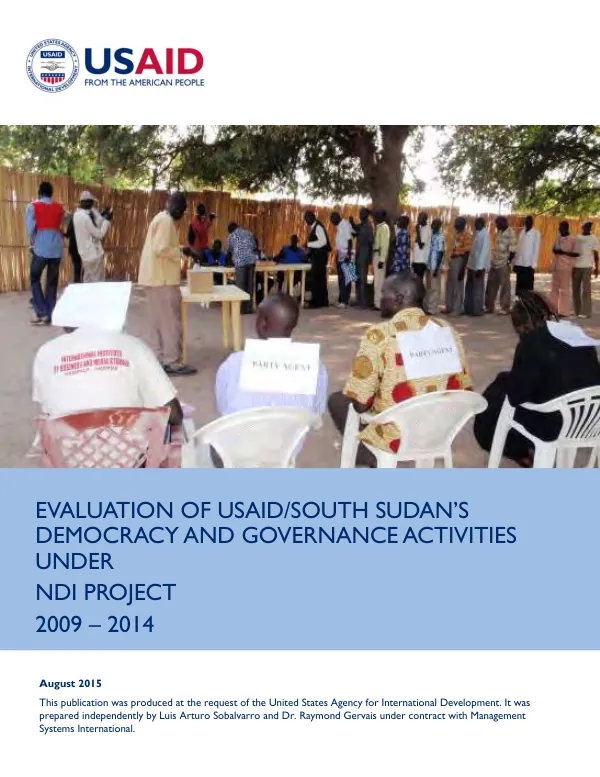
EVALUATION OF USAID/SOUTH SUDAN'S DEMOCRACY AND GOVERNANCE ACTIVITIES UNDER NDI PROJECT 2009 – 2014
Sign inMANAGEMENT SYSTEMS INTERNATIONAL
EVALUATION OF USAID/SOUTH SUDAN'S DEMOCRACY AND GOVERNANCE ACTIVITIES UNDER NDI PROJECT 2009 – 2014
The Comprehensive Peace Agreement (CPA) between the Government of Sudan (GoS) and the Sudan People's Liberation Movement/Army (SPLM/A) was signed in January 2005, marking a significant step towards ending the country's long civil war and achieving potentially long-lasting peace.
2015 · 71 pages
Sign in to readA free account is required to download.
Abstract
The agreement included a series of important political milestones, including the 2010 nationwide elections and the 2011 referendum to determine whether Southern Sudan would secede or remain with the Khartoum-led regime. The CPA's implementation relied heavily on the support of the international community, with countries from around the globe and multi-lateral organizations investing considerable resources to guide the process and ensure its progress. The United States Agency for International Development (USAID) played a leading role in this effort, as part of its comprehensive strategy to support the CPA's implementation. The National Democratic Institute (NDI) provided crucial advice, guidance, and technical support to ensure widespread knowledge, understanding, citizen participation, and ultimately, legitimacy to the CPA's most important milestones. The CPA's implementation was a complex and challenging process, requiring significant backing from the international community. USAID's support was instrumental in ensuring the success of the CPA, with NDI playing a key role in providing technical assistance and guidance to the Government of Southern Sudan (GoSS) and other stakeholders. The CPA's implementation was marked by several key achievements, including the successful conduct of the 2010 nationwide elections and the 2011 referendum. The CPA's implementation also faced several challenges, including delays, logistical issues, and security concerns. Despite these challenges, the CPA's implementation made significant progress, with the Government of Southern Sudan (GoSS) making important strides in building its institutions and capacity. The CPA's implementation also had a positive impact on the people of Southern Sudan, with many benefiting from improved access to education, healthcare, and economic opportunities. The CPA's legacy continues to shape the politics and governance of South Sudan, with the country's leaders working to build on the progress made during the CPA's implementation. The CPA's implementation also serves as a model for other peace processes and conflict resolution efforts around the world, highlighting the importance of international support and cooperation in achieving lasting peace and stability. The National Democratic Institute (NDI) played a crucial role in supporting the CPA's implementation, providing technical assistance and guidance to the Government of Southern Sudan (GoSS) and other stakeholders. NDI's support helped to ensure widespread knowledge, understanding, and citizen participation in the CPA's implementation, ultimately contributing to the success of the agreement.