USAID DEC
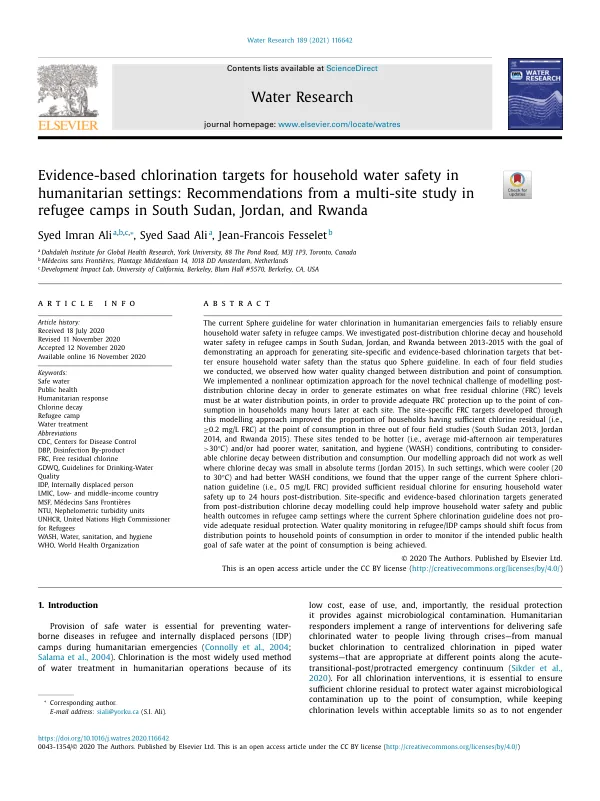
Evidence-based chlorination targets for household water safety in humanitarian settings: Recommendations from a multi-site study in refugee camps in South Sudan, Jordan, and Rwanda
Sign inMÉDECINS SANS FRONTIÈRES
Evidence-based chlorination targets for household water safety in humanitarian settings: Recommendations from a multi-site study in refugee camps in South Sudan, Jordan, and Rwanda
The Sphere guideline for water chlorination in humanitarian emergencies fails to reliably ensure household water safety in refugee camps.
2021 · 16 pages
Sign in to readA free account is required to download.
Abstract
Initial assessments conducted in refugee camps in South Sudan, Jordan, and Rwanda between 2013-2015 identified significant challenges in maintaining sufficient chlorine residual in water supplies. Chlorine decay between distribution and consumption was observed to be substantial, particularly in settings with high temperatures and poor water, sanitation, and hygiene (WASH) conditions. Implementation of a nonlinear optimization approach for modelling post-distribution chlorine decay was undertaken to generate site-specific and evidence-based chlorination targets. This approach aimed to estimate the free residual chlorine (FRC) levels required at water distribution points to provide adequate FRC protection up to the point of consumption in households many hours later. The site-specific FRC targets developed through this modelling approach were found to improve the proportion of households having sufficient chlorine residual at the point of consumption in three out of four field studies. The study sites were characterized by varying temperature and environmental conditions, with South Sudan, Jordan, and Rwanda experiencing hot and cool temperatures, respectively. The results showed that the site-specific FRC targets were effective in improving household water safety in settings with high temperatures and poor WASH conditions. In contrast, the upper range of the current Sphere chlorination guideline (0.5 mg/L FRC) provided sufficient residual chlorine for ensuring household water safety up to 24 hours post-distribution in settings with cooler temperatures and better WASH conditions. The study's findings have significant public health implications, particularly in refugee and internally displaced person (IDP) camps during humanitarian emergencies. The Sphere FRC target, which is widely used in refugee/IDP camp water systems globally, is based on conventions from the routine operation of municipal piped water systems in cities. However, this target may not provide sufficient residual protection in situations where the point of consumption is spatially and temporally distant from the point of distribution, as is commonly the case in refugee/IDP camps. The study's objective was to demonstrate an approach for generating site-specific and evidence-based chlorination targets for refugee/IDP camp water systems. The approach developed here forms the basis of an operational support tool that assists refugee/IDP camp water system operators in generating site-specific chlorination targets to keep water safe to drink for the entire duration of household storage and use. The study's results suggest that site-specific and evidence-based chlorination targets could help improve household water safety and public health outcomes in refugee camp settings where the current Sphere chlorination guideline does not provide adequate residual protection.
![Identification of Candidate Genes Controlling Black Seed Coat and Pod Tip Color in Cowpea (Vigna unguiculata [L.] Walp)](https://covers.devme.ai/gen/147712.webp)