USAID DEC
Evidence Review on the Motivations and Incentives to Engage, Join or Support Violent Groups
Sign inTHE AMERICAN INSTITUTES FOR RESEARCH
Evidence Review on the Motivations and Incentives to Engage, Join or Support Violent Groups
The learning agenda for conflict and violence prevention (CVP) was established by USAID's Bureau for Conflict Prevention and Stabilization and Center for Conflict and Violence Prevention in partnership with the Armed Conflict Location and Event Data Project (ACLED), American Institutes for Research (AIR), and Alliance for Peacebuilding (AfP).
2023 · 14 pages
Sign in to readA free account is required to download.
Abstract
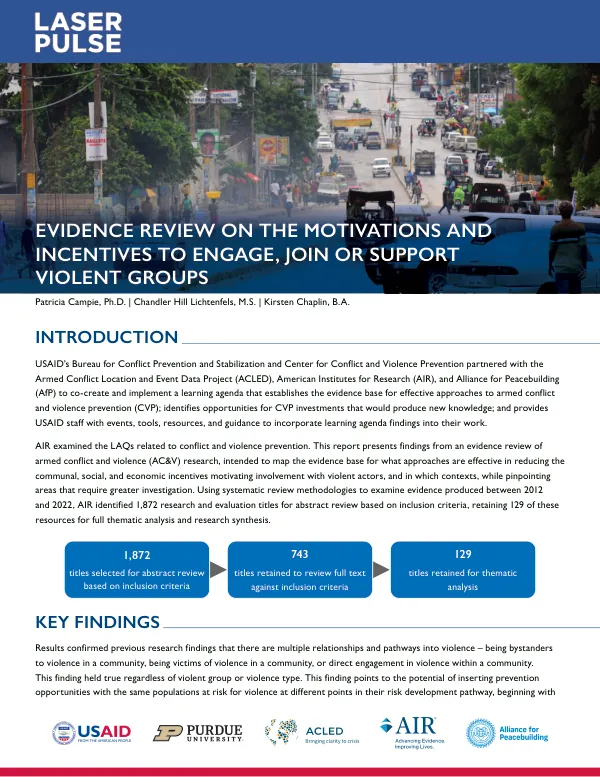
The agenda aims to establish an evidence base for effective approaches to CVP, identify opportunities for CVP investments, and provide USAID staff with events, tools, resources, and guidance to incorporate learning agenda findings into their work. AIR examined the learning agenda questions (LAQs) related to conflict and violence prevention. An evidence review of armed conflict and violence (AC&V) research was conducted to map the evidence base for what approaches are effective in reducing the communal, social, and economic incentives motivating involvement with violent actors, and in which contexts. The review used systematic review methodologies to examine evidence produced between 2012 and 2022. A total of 1,872 research and evaluation titles were selected for abstract review based on inclusion criteria, with 129 resources retained for full thematic analysis and research synthesis. Results confirmed previous research findings that there are multiple relationships and pathways into violence, including being bystanders to violence in a community, being victims of violence in a community, or direct engagement in violence within a community. This finding held true regardless of violent group or violence type, pointing to the potential of inserting prevention opportunities with the same populations at risk for violence at different points in their risk development pathway. The review also found that while there is more research than ever being done with former or current perpetrators, many studies with perpetrators were rated as producing evidence with questionable or low credibility. Four interventions were identified in the review, including a community engagement with police strategy, a bringing in the bystander high school curriculum, a research and action on social polarizations strategy, and a counter-narratives strategy. The interventions were tested in different locations, including South Africa, the United States, and Canada, with varying levels of success. The review confirmed that there are multiple relationships and pathways into violence, and that prevention opportunities can be inserted with the same populations at risk for violence at different points in their risk development pathway. The review also highlighted the need for more research on prevention strategies that support victims of violence and address root causes of violence. Recommendations from the review include investing in prevention strategies for populations with chronic exposure to violence, investing in prevention strategies that support victims of violence, investing in prevention strategies that address root causes of violence, and developing actionable guidance for researchers working with former or current perpetrators.