USAID DEC
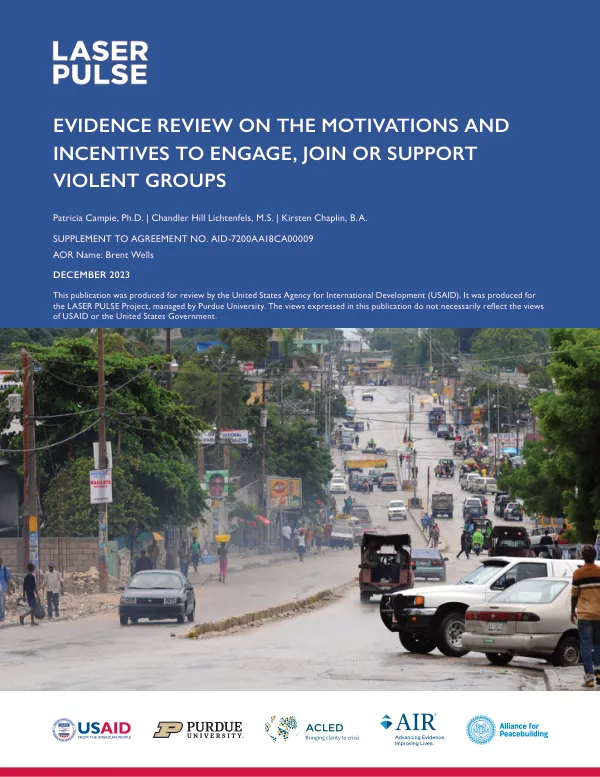
Motivations and Incentives to Engage, Join, or Support Violent Groups—Monitoring, Evaluation, & Learning (MEL)
Sign inCATHOLIC RELIEF SERVICES ORGANIZATION
Motivations and Incentives to Engage, Join, or Support Violent Groups—Monitoring, Evaluation, & Learning (MEL)
The research aims to better understand the current state of measurement with regard to motivations and incentives to engage, join, and/or support violent groups.
2023 · 28 pages
Sign in to readA free account is required to download.
Abstract
The resulting report explores the general characteristics of relevant resources to date, including research outcomes, explicit indicators, common measurement trends, and indicator examples. This report analyzed 73 resources, from which 261 indicators were extracted for analysis. The findings of this report underscore the intricate measurement landscape associated with motivations and incentives, highlighting the diversity of indicators across three primary thematic outcome categories: violent extremism (VE), crime and violence, and violence prevention and resiliency building settings. Themes assessed across indicators included perceptions on levels of violence; violent group engagement and recruitment mechanisms; motivations and incentives for engaging with violent groups; proximity to violence; social cohesion; and resiliency/risk factors; amongst others. The research identified existing indicators and measures as examples of the current state of measurement. While included resources aim to better understand motivations that incentivize engagement with violent groups and actors across various conflict contexts and forms of violence, the indicators employed extend beyond merely measuring motivations and incentives, touching upon multiple aspects of the conflict context. To advance the state of measurement, researchers and implementers need to establish explicit indicators to monitor and evaluate changes in motivations and incentives. To obtain a more holistic and accurate understanding of the underlying phenomenon, it is imperative to develop and assess indicators across the micro, meso, and macro levels with equal rigor. A deeper understanding of the contribution of these various factors and elements in relation to violence, including its potential disruption, could be achieved through more focused, context-specific assessments. The research was conducted as part of the Conflict and Violence Prevention Learning Agenda Implementation Team (CVP LAIT), a collaborative effort between the Alliance for Peacebuilding (AfP) and the Bureau for Conflict Prevention and Stabilization (CPS). The CVP LAIT was tasked with co-creating and implementing a learning agenda that establishes the evidence base for effective approaches to armed conflict and violence prevention, identifies opportunities for investments that would produce new knowledge, and provides USAID staff with events, tools, resources, and/or guidance to incorporate learning agenda findings into their work. The research involved an intensive, multi-stakeholder consultation process with USAID Washington and mission staff to identify incentives that motivate involvement with violent actors. The resulting report provides a comprehensive overview of the current state of measurement and highlights the need for more focused, context-specific assessments to advance our understanding of the underlying phenomenon. The research outcomes underscore the complexity of the measurement landscape associated with motivations and incentives, highlighting the diversity of indicators across various thematic outcome categories. The findings emphasize the need for more explicit indicators to monitor and evaluate changes in motivations and incentives, as well as the importance of developing and assessing indicators across multiple levels with equal rigor. The report provides a detailed analysis of the indicators and measures employed in the research, highlighting the diversity of themes and aspects of the conflict context that are being measured. The findings suggest that a more holistic and accurate understanding of the underlying phenomenon can be achieved through more focused, context-specific assessments that take into account the complex interplay of factors and elements in relation to violence. The research has implications for the development of more effective approaches to armed conflict and violence prevention, highlighting the need for more explicit indicators to monitor and evaluate changes in motivations and incentives. The report provides a comprehensive overview of the current state of measurement and highlights the need for more focused, context-specific assessments to advance our understanding of the underlying phenomenon.