USAID DEC
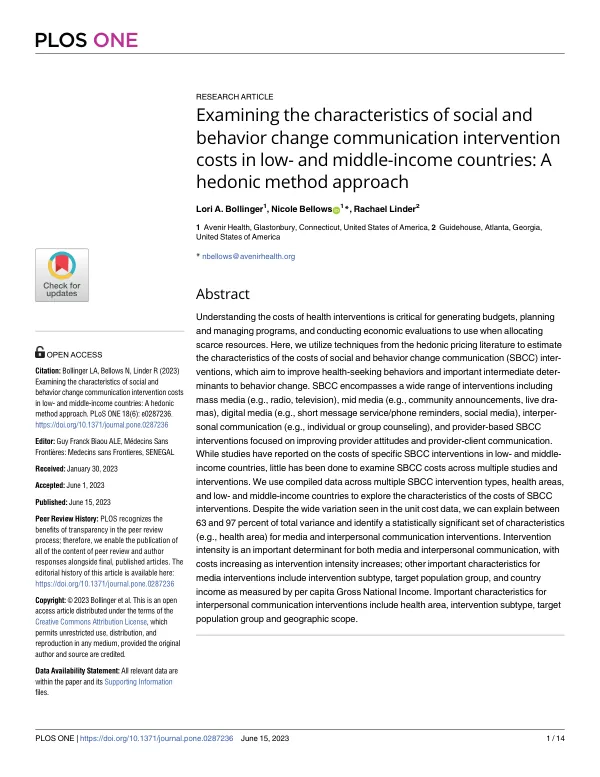
Examining the characteristics of social and behavior change communication intervention costs in low- and middle-income countries: A hedonic method approach
Sign inAVENIR HEALTH
Examining the characteristics of social and behavior change communication intervention costs in low- and middle-income countries: A hedonic method approach
Social and behavior change communication (SBCC) interventions aim to improve health-seeking behaviors and intermediate determinants to behavior change in low- and middle-income countries.
2023 · 14 pages
Sign in to readA free account is required to download.
Abstract
These interventions encompass a wide range of activities, including mass media, mid media, digital media, interpersonal communication, and provider-based interventions. Understanding the costs of SBCC interventions is critical for generating budgets, planning programs, and conducting economic evaluations to allocate scarce resources. The costs of SBCC interventions vary widely, driven by differences in the unit of analysis and contextual factors. A recent review compiled and examined the existing literature on SBCC intervention costs, making the data accessible to others via the SBCC Cost Repository and the Global Health Cost Consortium's Unit Cost Study Repository. This analysis utilizes SBCC unit costs to explore the relationship between a set of underlying characteristics of SBCC interventions and their costs, as reported in the literature. The dataset used in this analysis includes 147 cost studies with a total of 847 cost observations, of which 355 cost observations were unit costs and 120 of these unit costs were comparable enough for synthesis purposes. The SBCC intervention categories included in the analysis were interpersonal communication, mass media, packages delivering more than one SBCC intervention category, other SBCC intervention types, and studies with more than one SBCC intervention category. The median unit costs varied by SBCC intervention, driven largely by differences in the unit of analysis and other contextual factors. The analysis utilized SBCC unit cost estimates that are comparable enough for analytical purposes, including estimates for media, interpersonal communication, and provider-based interventions, and for multiple health areas, including family planning/reproductive health, HIV, malaria, and maternal, newborn and child health. The potential list of SBCC intervention characteristics hypothesized to be statistically related to the reported unit costs of the intervention includes a series of categorical variables for the health areas and SBCC interventions listed above. The results of the analysis showed that intervention intensity is an important determinant for both media and interpersonal communication, with costs increasing as intervention intensity increases. Other important characteristics for media interventions include intervention subtype, target population group, and country income as measured by per capita Gross National Income. Important characteristics for interpersonal communication interventions include health area, intervention subtype, target population group, and geographic scope. The analysis explained between 63 and 97 percent of total variance and identified a statistically significant set of characteristics for media and interpersonal communication interventions. The findings of this analysis have implications for SBCC budgeting and program planning. Understanding the characteristics of SBCC intervention costs can enable one to estimate more specific unit SBCC cost estimates based on the intervention's characteristics, thus improving SBCC budgeting and program planning. The results of this analysis can inform the development of more effective and efficient SBCC interventions in low- and middle-income countries.
Related documents