USAID DEC
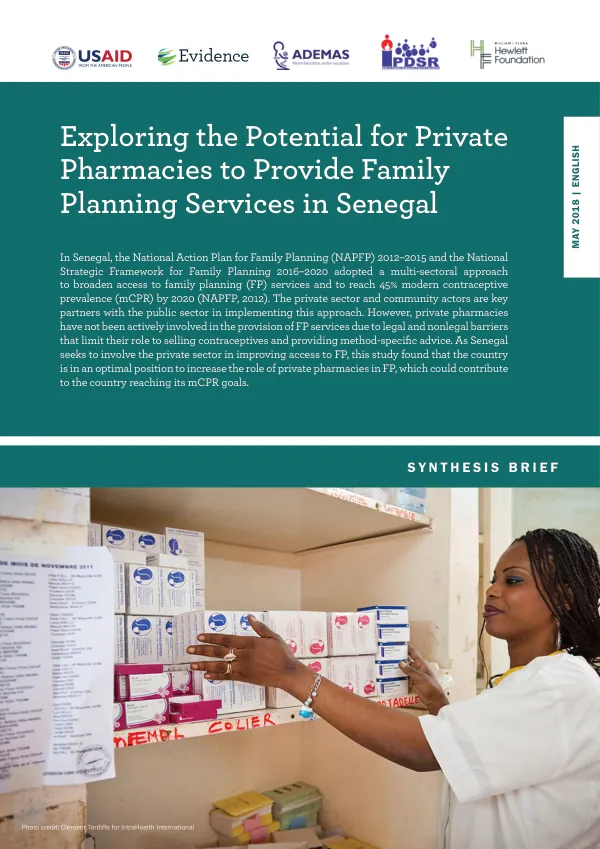
Exploring the Potential for Private Pharmacies to Provide Family Planning Services in Senegal
Sign inINTRAHEALTH
Exploring the Potential for Private Pharmacies to Provide Family Planning Services in Senegal
The National Action Plan for Family Planning (NAPFP) 2012-2015 in Senegal aimed to increase the modern contraceptive prevalence rate (mCPR) from 12% in 2012 to 27% in 2015 and to 45% in 2020.
2018 · 16 pages
Sign in to readA free account is required to download.
Abstract
Between 2012 and 2014, the mCPR increased by four percentage points annually, reaching 20% in 2014. However, the rate of increase began to slow, with the mCPR only reaching 21% in 2015. The unmet need for family planning (FP) remains high at 25% among women in union. The Population Council conducted an exploratory study in 2015 on the potential role of private pharmacies in the provision of FP services in Senegal. The study aimed to explore the barriers to, and opportunities for, the provision of FP services by private pharmacies. The study found that private pharmacies in Senegal play a minor role in FP service provision, with their role often limited to the sale of FP methods, method-specific advice, and referrals. The study identified several barriers to private pharmacies participating in the delivery of FP counseling and services, including legal restrictions. The Code of Public Health, the Pharmacists Code of Ethics, Law of Reproductive Health, and pharmaceutical policies regulating drug sales restrict the role of private pharmacies in FP provision. Many private pharmacists in Senegal consider the texts governing "dispensary pharmacy" outdated, including the law from April 15, 1954, which regulates all health professionals in Senegal. Other barriers to pharmacists participating in the delivery of FP counseling and services were identified, including the lack of or insufficient training of pharmacists in contraceptive technology; insufficient space within pharmacies for private counseling; unavailability of contraceptive products; lack of counseling materials; the high cost of certain brands of FP methods; and some pharmacists' attitudes about clients' age, marital status, or religious beliefs, that influence which services to offer. The study also found that perceptions around the potential role of private pharmacies have evolved. In 2012, a Population Council study found some providers (including pharmacists) were reluctant to offer emergency contraception in private pharmacies. However, by 2015, clients, key FP stakeholders, and private pharmacists themselves were more accepting of the idea of offering emergency contraception. The study suggests that the country is in an optimal position to increase the role of private pharmacies in FP, which could contribute to the country reaching its mCPR goals. The study recommends that necessary policy revisions be made to allow private pharmacies to provide FP services, including updating the Code of Public Health and the Pharmacists Code of Ethics to reflect the changing role of private pharmacies in FP provision. The study also recommends that training programs be established to equip pharmacists with the necessary skills and knowledge to provide FP counseling and services. Additionally, the study recommends that private pharmacies be provided with the necessary resources and support to enable them to offer FP services, including the availability of contraceptive products and counseling materials. Overall, the study highlights the potential for private pharmacies to play a greater role in the provision of FP services in Senegal, and recommends that necessary policy and programmatic changes be made to enable this to happen.