USAID DEC
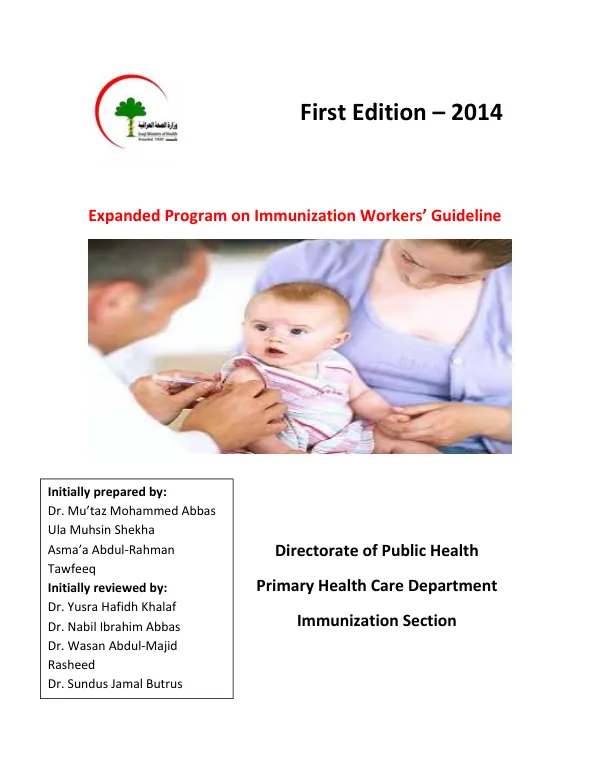
Expanded Program on Immunization Workers’ Guideline
Vaccination is a key intervention that has significantly contributed to improving public health by preventing communicable diseases and reducing morbidity and mortality among all community groups, especially children.
2014 · 64 pages
Sign in to readA free account is required to download.
Abstract
The positive impact of vaccination and its significant outcomes align with two other key interventions: provision of safe water and use of antibiotics. Edward Jenner, an English scientist, is credited with the discovery of vaccination in 1796. He observed that milkmaids infected with cowpox in the form of blisters on their hands did not get infected with smallpox, a fatal disease at that time. Jenner scraped pus from cowpox blisters and inoculated a boy named James Phipps by two long cuts in the skin of his arm. About six weeks later, Jenner inoculated the boy with smallpox, which had no effect, and concluded that he now had complete protection against smallpox. The term "vaccination" was derived from the Latin name of cowpox, "Vaccinia." Jenner's experiment was considered a breakthrough and starting point in the concepts of preventive medicine. In 1885, French scientist Louis Pasteur discovered the rabies vaccine and saved lives of people infected with this disease. The history of vaccine production includes significant milestones such as the production of diphtheria vaccine in 1923, pertussis vaccine in 1926, polio (IPV dead Salk) vaccine in 1955, and polio (Oral Sabin) vaccine in 1960. Measles vaccine was produced in 1964. There have been more achievements in producing vaccines against other diseases or improving the quality of those already used. Smallpox was eradicated worldwide in 1979, and now all countries seek to eradicate and control other communicable diseases through government health programs and cooperation with international organizations such as WHO and UNICEF. Immunization is any intervention or means that aims to provide advance immunity and protection against diseases and their symptoms and complications that could cause disability or death. A vaccine is a substance administered to humans in order to stimulate the immune system to confront and eliminate the causative agent of diseases or their poisons when they entered the human body. Vaccines can be classified into several types, including live, attenuated (weakened) bacteria, inactivated/killed bacteria, and subunit vaccines. Live, attenuated vaccines contain a weakened form of the disease-causing agent, while inactivated/killed vaccines contain a killed form of the agent. Subunit vaccines contain only a portion of the disease-causing agent. Poliomyelitis disease, also known as polio, is a highly infectious disease caused by the poliovirus. The disease can lead to paralysis, muscle weakness, and even death. The polio vaccine is available in two forms: the inactivated poliovirus vaccine (IPV) and the oral poliovirus vaccine (OPV). The IPV is given as an injection, while the OPV is given orally. The BCG vaccine is used to protect against tuberculosis (TB), a bacterial infection that primarily affects the lungs. The hepatitis B vaccine is used to protect against hepatitis B, a viral infection that can cause liver disease. Diphtheria is a bacterial infection that affects the throat and upper respiratory tract. The diphtheria vaccine is available in several forms, including the diphtheria and tetanus toxoids and pertussis (DTP) vaccine. The pertussis vaccine is used to protect against pertussis, also known as whooping cough, a highly contagious respiratory infection. Tetanus is a bacterial infection that affects the nervous system, causing muscle stiffness and spasms. The tetanus vaccine is available in several forms, including the Td vaccine for adults and the DT vaccine for children. Neonatal tetanus is a form of tetanus that affects newborn babies. The disease is caused by the bacterium Clostridium tetani, which is found in the environment and can enter the body through cuts or wounds. Neonatal tetanus prevention involves administering the tetanus vaccine to pregnant women and providing proper wound care to newborn babies. Examples of successful neonatal tetanus prevention programs have been implemented in several countries, including Bangladesh and Nepal. Haemophilus influenzae type b (Hib) is a bacterial infection that affects the respiratory tract and can cause meningitis, a serious and potentially life-threatening infection. The Hib vaccine is available in several forms, including the Hib conjugate vaccine and the Hib polysaccharide vaccine. Measles is a viral infection that affects the respiratory tract and can cause serious complications, including pneumonia and encephalitis. The measles vaccine is available in several forms, including the measles, mumps, and rubella (MMR) vaccine. Mumps is a viral infection that affects the salivary glands and can cause serious complications, including meningitis and encephalitis. The mumps vaccine is available in several forms, including the MMR vaccine. Rubella is a viral infection that affects the respiratory tract
Related documents
Documents in this collection
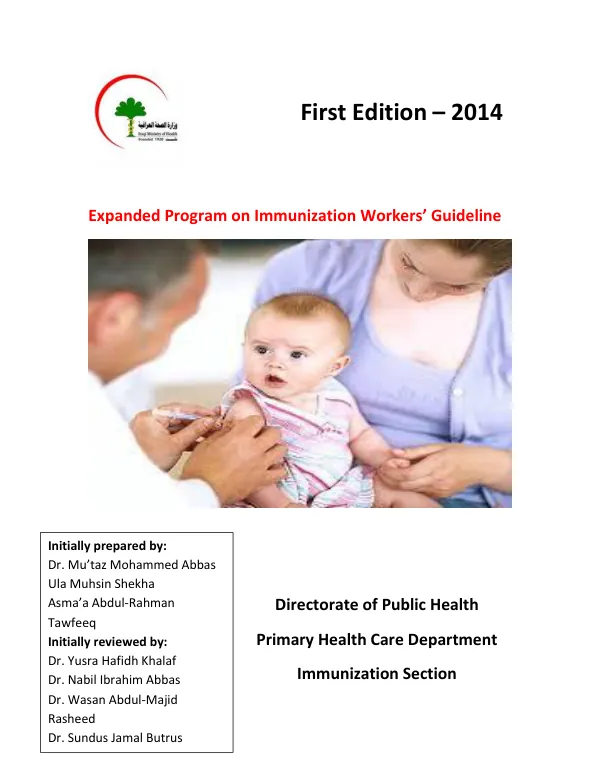 2014
2014USAID DEC
Expanded Program on Immunization Workers’ Guideline
Open record
USAID DEC
National Immunization Schedule for India
Open record
USAID DEC